The scariest part of building isn't building. It's telling people you built something and waiting to see if they care.
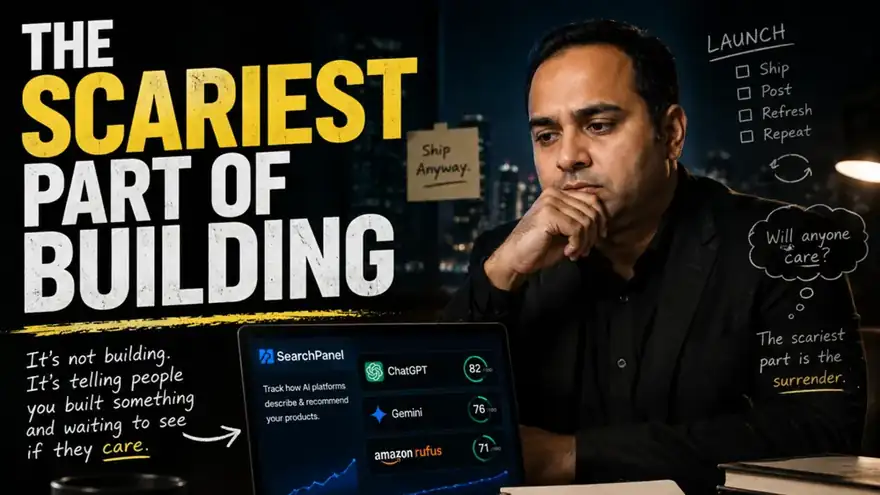
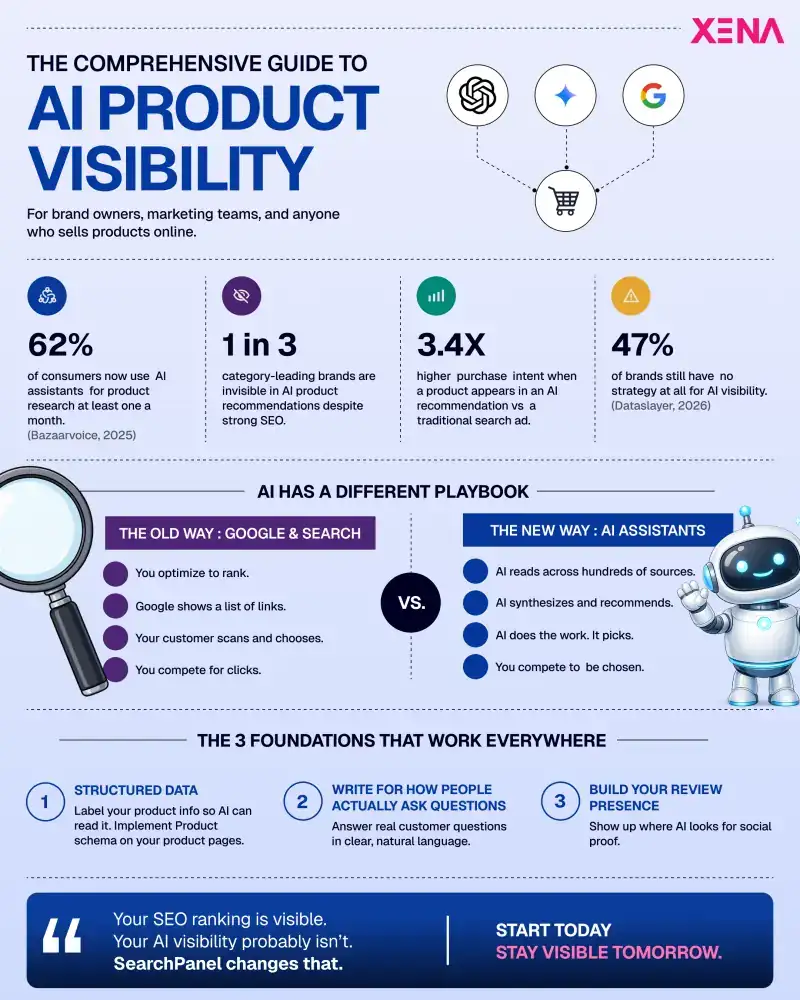
Last week I launched SearchPanel (opens in a new tab) . It's a tool that scores how AI platforms like ChatGPT, Gemini, and Amazon Rufus describe and recommend products. I think it's useful. I'm pretty sure I'm right about that.
But the night before launch, I sat at my desk in Louisville at 2 AM rewriting the announcement post for the seventh time. Not because the copy was bad. Because every version felt like it was begging.
You can build the most elegant piece of software in the world. You can stress-test it, validate it, get the buttons exactly the right shade of blue. The hard part starts when you have to walk outside and say "look at this."
I have launched things before. Xenalytics. Xena360. A dozen smaller features that mattered to maybe four people. Each launch, I tell myself this is the one where I won't feel sick beforehand. Each launch, I feel sick anyway.
The first time I cold-emailed a brand from my apartment during the pandemic, I hit send and immediately closed my laptop. Walked out of the room. Couldn't look at the screen for an hour. I had asked for nothing more than a 15-minute call. I knew rationally that the worst possible outcome was silence. My body did not know that.
Five years later, I have closed contracts with Nestlé. I have stood on stages and won over a million dollars in pitch competitions. None of it has cured the thing I felt that first afternoon in my apartment. The fear has just learned to dress better.
When I launched SearchPanel last Tuesday, I refreshed LinkedIn 40 times in the first hour. I told myself I was checking for typos. I was not checking for typos. I was checking to see if anyone, anyone at all, had liked it.
Here is what I have learned, slowly, after five years of doing this on my own.
Building is a private act. You sit in a room. You make decisions. The code does what you tell it. The slide deck does what you tell it. You are in control of the entire universe until the moment you ship.
The moment you ship, you are no longer in control. The work belongs to other people now. They get to decide if it matters. They get to ignore it. They get to misunderstand it. They get to point out the obvious flaw you missed at minute three.
That handoff is the scariest part. Not the labor. The surrender.
I have a theory about why founders procrastinate on launches. We tell ourselves we are polishing. We tell ourselves the timing isn't right. We tell ourselves we need one more feature. What we are really doing is delaying the moment we have to find out if we were wrong.
Every launch is a small confession. You are saying out loud, in front of everyone you respect, that you believed in something enough to spend your nights and weekends and a chunk of your twenties on it. If nobody cares, that belief looks foolish in retrospect. And the worst part is, you said the words. You can't take them back.
I have made peace with this by accepting that it never goes away. Not for me. Maybe not for anyone who builds things alone.
So I ship anyway. I write the post. I refresh the feed. I let the silence be what it is for the first few hours. And then I get up and build the next thing.
Because the alternative is sitting in the room forever, with something I made that nobody will ever see, telling myself I was waiting for the right moment.
The right moment isn't a moment. It's just the next time you decide to be brave.
Onwards!
Get the next entry. Founder's Diary lands on LinkedIn first. Behind-the-scenes moments go on Instagram.