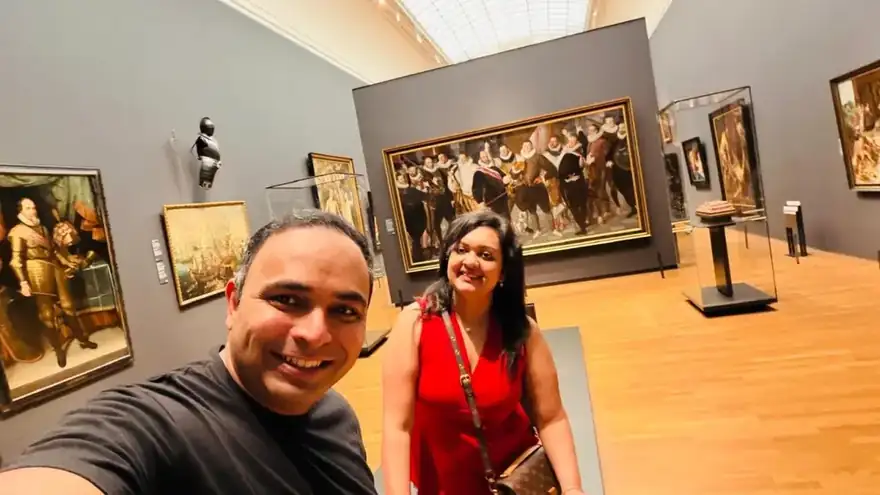
Founders without family support
Most of my founder peers don't have family support.
I didn't understand how rare mine was until I started collecting other people's stories without meaning to. It happens at the edges of events, after the panels end and the badges come off. Someone orders a second drink, the polish drops, and they tell you the thing they'd never put on LinkedIn.
One founder told me his wife had given him a deadline. Not a supportive "let's check in next quarter" deadline. A real one. If the company didn't hit a number by a certain date, he was getting a job. He was pitching investors by day and rehearsing how to tell his own house he'd failed by night. I watched him present the next morning. Polished. Confident. Nobody in that room knew he was carrying two clocks at once, and that the louder one wasn't ticking for the investors. It was ticking at home.
Another peer, a genuinely brilliant operator, the kind of person you'd back on instinct alone, told me his parents still introduce him at family functions as "between things." He's three years in. He has real customers. And every holiday he walks back into a room where the people who raised him quietly believe he's lost his way. He told me he'd stopped talking about the company at family dinners entirely. Not because nothing was happening, but because every update got met with the same careful, pitying silence, the kind that makes a win feel like something you have to apologize for.
There was a third. We were at a conference hotel bar, the kind of fluorescent late-night conversation that only happens when both people are too tired to perform. He told me his marriage was quietly cracking under the company. Not from fighting. From absence. He'd been so deep in survival mode for so long that he'd become a ghost in his own house, and his wife had stopped expecting him to be present even when he was physically there. "She didn't sign up for this version of me," he said. He wasn't sure the company was worth what it was costing him at home, and he wasn't sure he could stop either. He just sat with that, turning the glass in his hand.
I started seeing the pattern everywhere once I knew to look for it. The quiet dinners where nobody asks how the company is doing, because the answer always lands like bad news and everyone's tired of bracing for the fall. The spouse who keeps the smile up in public and saves the real conversation for the car ride home. The slow erosion that has nothing to do with the market and everything to do with the people you come home to.
I used to think the hardest part of building a company was the company.
It isn't.
The hardest part is doing it while the people closest to you are silently hoping you'll stop.
Here's what I keep coming back to about my own situation, and why I don't take it for granted for a single day.
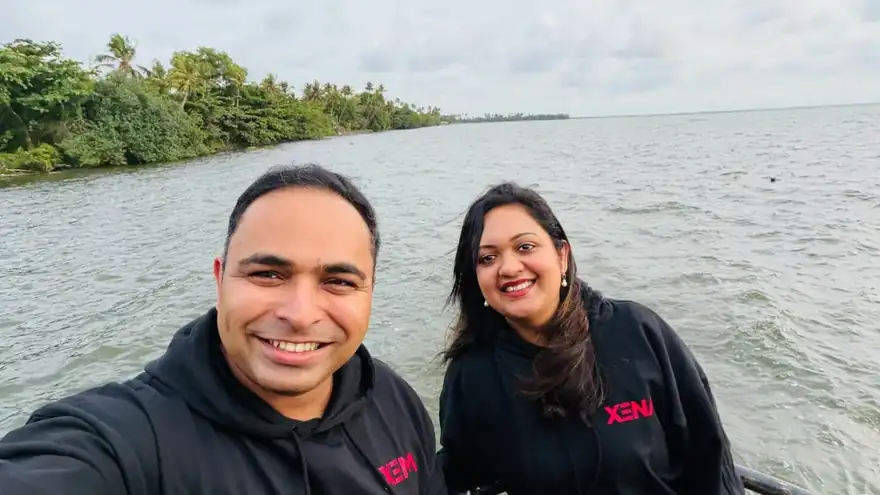
When I left a stable path to build Xena, I wasn't doing it from a position of comfort. I was a first-generation immigrant in a city where I knew almost no one, building a company over cold email from Louisville, a place that doesn't exactly light up the venture capital map. I had no local network, no safety net of old friends, no warm intros waiting. By every reasonable measure, this was the precise moment for someone who loved me to gently talk me out of it.
Sana didn't.
She never once asked me to walk her through the spreadsheet to justify the risk. She never asked me to prove the dream deserved the gamble. When I'd surface from a 2am session, eyes wrecked, having rewritten the same pitch for the tenth time, the house was calm instead of tense. That sounds like a small thing. It is not a small thing. A tense house at 2am is its own slow poison, and across all those years, I never once had to drink it.
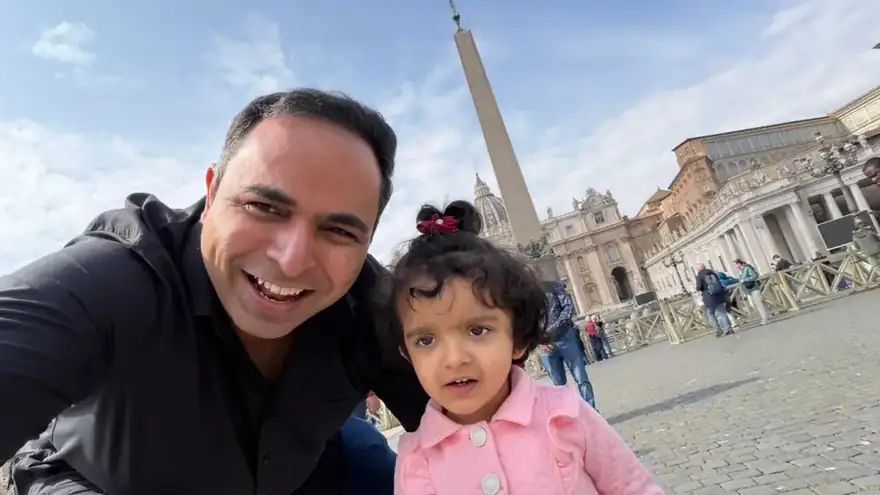
I remember the night before one of the bigger competitions. I'd been spiraling, running worst-case scenarios on a loop, deep in that specific pre-game dread that convinces you you're a fraud who somehow got lucky and is about to be found out in public. Sana didn't give me a speech. She didn't try to argue me out of the spiral or fix my deck. She just made the evening aggressively normal. Dinner, kid, regular noise. Kiara was being a kid, completely oblivious to the stakes, tugging at me to come look at something she'd built, and for twenty minutes I forgot I was supposed to be terrified.
That's the part nobody warns you about. Sometimes the most valuable thing in the world isn't encouragement. It's a daughter who has no idea you might bomb tomorrow and wouldn't care if she did, which turns out to be its own kind of medicine. She wasn't impressed by my pitch. She didn't know what a pitch was. She wanted me to look at her LEGO build, and she wanted my full attention while I did it. And somehow that one demand, look at this thing I made, recalibrated my entire nervous system. The stakes I'd been inflating all evening got cut back down to their real size.
I won that competition. But the version of me that walked on stage the next morning was built the night before, at a dinner table, by people who had no idea they were doing it.
There's another memory I come back to. A stretch where things were genuinely grim. A deal had stalled, old notes were maturing, deadlines were stacking up, and I was in that brutal fog where you honestly cannot tell if you're building something real or just refusing to admit it's already over. I came home heavy that night, the kind of heavy you can't hide. Sana could read it on my face. She didn't ask for the financial breakdown. She didn't need the play-by-play. She just said some version of "okay, so what's the next move," and the company became a problem we were standing in front of together instead of a weight I was carrying alone. That reframe, from my problem to our problem, is worth more than most of the advice I've ever paid for.
People talk about runway like it's only money in a bank account.
There's another kind of runway entirely. It's the emotional cushion that lets you take a real swing without flinching, because you know that if the swing misses, you still land somewhere soft. That cushion never shows up on a cap table. No investor asks about it in diligence. There's no line item for it. But it is quietly the reason some founders can keep getting up after losses that would flatten a person who goes home to a cold room and a colder conversation.
I've lost competitions in front of crowds. I've had deals fall through after I'd already let myself believe. I've had the months where the math doesn't work and the doubt is loud and the obvious, logical, responsible move is to fold the hand and walk away. And every single time, the thing that reset me wasn't a motivational quote or a new productivity system or a better morning routine. It was walking through my own front door and being met by people who were glad I was there, completely regardless of the scoreboard.
Here's what I've come to believe...
Family support isn't a nice-to-have. It's infrastructure.
You can be the most relentless person in any room and still get slowly worn down by a home that treats your dream like a phase you're supposed to grow out of. And you can be a perfectly average operator who outlasts everyone in your cohort for one deeply unglamorous reason. You have people behind you who refuse to let you fold, so you simply stay in the game longer than the ones who were quietly bleeding out at home the whole time.
Because endurance is the entire game. Most companies don't die from one clean fatal blow. They die because the founder ran out of the will to absorb just one more bad week. They die in the gap between "this is hard" and "I can't do this anymore," and that gap is almost always shorter for the founder who's fighting the market and the dinner table at the same time. Support is what refills the tank that the work keeps draining.
So, two things.
If you have that support, name it out loud. Don't let it stay invisible just because it's reliable, because the most dependable support is exactly the kind we stop noticing. Thank the people giving it to you, by name, in specifics. They are carrying weight that never gets counted, never gets equity, never gets a line in the funding announcement. They are co-building the company in every way that matters. They just don't get the title or the carry.
And if you're a founder who doesn't have it, I won't insult you by pretending that's a small thing or that you can just hustle your way past it. It's a real disadvantage, and it is not your fault. But you can build your own version of it. Find the friends, the mentors, the founder group that says "keep going" when your own house goes quiet. Manufacture the cushion if you weren't handed one, because it is that important to whether you make it. Don't try to be the lone hero. That story sells in movies and kills people in real life.
Nobody builds anything alone.
The lucky ones just know exactly who's standing behind them.
And the wise ones never stop saying thank you.
With love and support
Akhil
Get the next entry. Founder's Diary lands on LinkedIn first. Behind-the-scenes moments go on Instagram.