Choosing a Path With Basically No Guarantees. Founders deserve more credit.
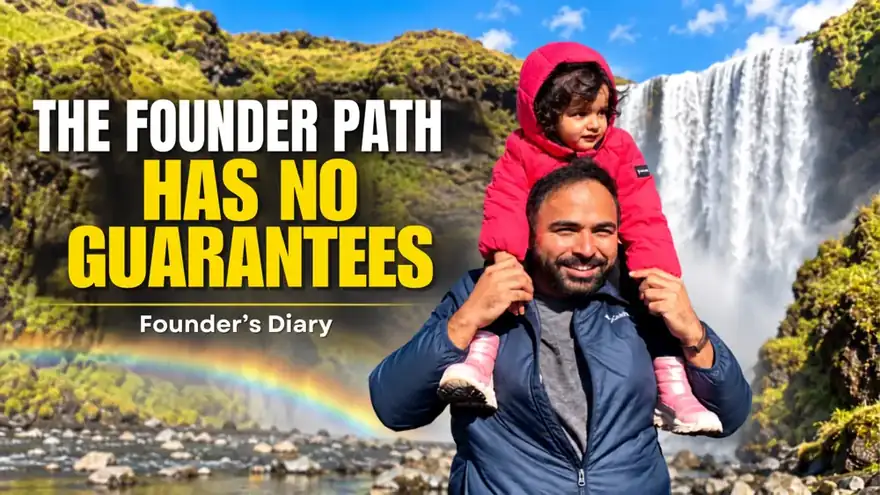
I have been keeping a journal for a while now. Most entries are not fit for public consumption, partly because they are boring and partly because they are honest, and those two things overlap more than you would think. But every so often a line shows up that I keep coming back to, and this week it was this one:
Founders should give themselves more credit for choosing a path where there are basically no guarantees.
I wrote that at 6:40 a.m. on a Tuesday, before my daughter woke up and before the first Slack notification, which is the only window of the day when I am capable of an original thought. Then I spent the rest of the week trying to figure out whether I actually believe it or whether it was just the coffee talking.
I think I believe it. Let me try to explain why, with the usual detours.
People love the word "leap" when they talk about founders. Take the leap. Made the leap. Leap of faith. It makes the whole thing sound athletic, like there was a running start and a landing and a judge holding up a scorecard.
There is no leap. There is a series of small, mostly unremarkable decisions where you choose the option with less certainty in it, over and over, until one day you look up and realize you have been doing this for years and there is no longer a normal job to go back to that would not feel like a demotion from a company of one.
For me the first of those decisions happened in Delhi. I was building e-commerce at Hindustan Times, which is a real company with real payroll and a real building, and I decided to leave that and go get an MBA at Babson, which is a real school with real tuition and no building that I owned. The version of this story I tell at pitch competitions makes it sound strategic. The honest version is that I had a feeling, and the feeling was expensive.
Then came the pandemic, and I was in Louisville, Kentucky, a city I had no particular reason to be in, with a laptop, an idea about Amazon data, and a network in the United States that could be generously described as "the people I had met at Babson and a guy from my apartment building who nodded at me once."
So I sent cold emails. Hundreds of them. The reply rate was what you would expect from a stranger emailing supply chain managers during a global emergency about a product that did not fully exist yet. Which is to say, most people were busy, and I was a Tuesday afternoon problem they did not need.
Somebody at Nestlé replied.
I want to be clear that I still do not fully understand why. I have a theory involving the subject line and a theory involving luck and a theory involving the specific person being bored on a specific afternoon, and I suspect the truth is a blend. But that reply became a conversation, and the conversation became a pilot, and the pilot became Xena Intelligence's first enterprise client. A solo founder in Kentucky with no U.S. network landing a global CPG company through unsolicited email is not a strategy I would recommend. It is, however, what happened.
Tom and Paul, or: the first people who trusted a stranger
Before Nestlé there were Tom and Paul.
They run a company called Go2Kits in Keene, New Hampshire. Keene is the kind of town where, if you have never been, you would guess correctly what it looks like. They were my first-ever clients. Not the first enterprise client, not the first "logo," just the first two humans who looked at what I was doing and said, essentially, "Fine. Let's see."
I think about them more than I think about most of the bigger wins, because the bigger wins came with some evidence. By the time larger brands were signing, there were case studies and testimonials and a deck with numbers in it. Tom and Paul had none of that. They had a guy with an accent, a Google Slides deck, and a great deal of confidence that was, at that point, entirely unearned.
They paid me anyway. Real money. Small, but real, and I remember staring at the invoice confirmation the way I imagine people stare at a positive pregnancy test: a mix of joy and "oh no, this is happening now."
Five years on, they are less like clients and more like people I call when I want to know if I am being an idiot. They have a very high hit rate. I would say this is the best return on any relationship I have made in business, except that it would sound like I am ranking my friends, which I am, but privately.
The point is: the earliest people who bet on you had the least information. Give them credit. And give yourself credit for being the kind of person they were willing to bet on with no information, because that is not nothing.
A brief accounting of things that did not come with a guarantee
I made a list. It is incomplete, but it makes the case.
- Leaving a stable job in India to study in a country where I knew almost no one.
- Choosing to start a company in a pandemic, in a city I did not live in yet, in a category (CPG on Amazon and Walmart) where the incumbents have budgets larger than my expected lifetime revenue.
- Going through Techstars NYC in 2022, which is a program that takes a small piece of your company in exchange for a large piece of your nervous system.
- Winning Render Capital, which is the reason I moved to Louisville permanently. I picked a city because an investor was there. I am aware that is not how most people choose where to raise a child.
- Pitching in Doha for TASMU. Pitching in Birmingham at Sloss.Tech (opens in a new tab) . Pitching in Zurich on a Kentucky trade mission, which is a sentence I would not have predicted for myself at any earlier point in my life.
- Entering, by my rough count, somewhere north of forty pitch competitions. Winning enough of them to total over $1.65 million. Losing enough of them to know that the judges' feedback forms are often more useful than the checks.
- Building a second product, SearchPanel, to track how brands show up in AI answer engines, at a moment when nobody could tell me whether "AI answer engine visibility" was a category or a phrase I had made up in the shower.
None of these had a guarantee attached. Most of them had a very strong prior of failure. Several of them were, by the standards of my parents' generation, actively irresponsible.
And here is what I keep landing on: I do not give myself credit for any of it. Not in the moment. In the moment, the only thing I feel is the next thing that is not done yet.
The Steve test
Let me tell you about Steve.
Steve owns a farm goods store here in Louisville. Not a tech company. Not a venture-backed anything. A store, with a door and a bell on the door. Xena Intelligence has been helping his business, and a few weeks ago we took a photo together for LinkedIn, which is the modern version of a handshake.
What struck me about Steve is that he had no framework for what I do. He did not care about AI visibility tracking or marketplace intelligence or the phrase "AEO," which I have said in more meetings than I would like to admit. He cared whether more people found his products and bought them. That was the whole conversation.
I have started using this as a test. If I cannot explain what Xena does in a way that would make Steve nod, I have overbuilt something. It is a humbling test. It has killed at least two features.
But it also reminded me of something about the no-guarantee path: the people it actually serves rarely know or care how risky it was for you to get there. Steve does not know about the cold emails. He does not know about the nights I refreshed a bank balance like it was a sports score. He knows the bell rings more often. That is the only metric that matters to him, and honestly, it should probably be the only one that matters to me.
On winning an award and feeling nothing for eleven minutes
Earlier this year I won the Martha Layne Collins Award for Excellence in AI and Digital Trade Innovation. It is a Kentucky award. It has a very long name. It came with a very nice plaque.
I stood at the podium, said thank you, took the photo, and then sat back down and checked my email. Eleven minutes, roughly, between the applause and the first "have you seen this ticket?" message from my team.
I am not saying this to be ungrateful. The award meant something. It still does. Seeing my name next to a former governor's on a piece of engraved glass is not a thing I expected when I was sending cold emails from a rented apartment. But I noticed the speed with which my brain filed it as "done" and moved on, and I think that speed is the real problem this diary entry is about.
Founders are calibrated to the next unsolved thing. It is an adaptive trait. It is also, over enough years, a way to never feel like you have done anything at all, despite a growing pile of evidence that you have. The evidence gets filed. The feeling gets skipped.
A few observations from the road, presented without commentary.
On being a solo founder. I do not have a cofounder. People ask about this constantly, usually with the concerned face people make when you tell them you are driving to Chicago alone. The upside is that every decision is mine. The downside is that every decision is mine. I have not yet found a third side.
On investor meetings. Every investor meeting is a form of theater in which one party pretends they have not already decided, and the other party pretends they have not noticed. The best meetings are the ones where both parties drop the pretense in the first five minutes and go get lunch.
On the phrase "we're excited to announce." I have written it at least sixty times. I have been genuinely excited perhaps eleven of those times. The other forty-nine were closer to "we are relieved to announce" or "we are legally permitted to announce," neither of which performs well on LinkedIn.
On pitch competitions. You know you have done too many when you can predict the exact second a judge will ask about customer acquisition cost, and you have a slide ready for it, and you are slightly disappointed when they do not ask.
On the Amazon marketplace. It is the only environment I know of where a two-star review titled "Great product" can tank a quarter. I have made peace with this. Peace is a strong word.
On raising a two-year-old while running a startup. Both involve a small stakeholder who cannot articulate what they want, communicates primarily through escalation, and is somehow always right. My daughter, Kiara, has better product instincts than most people I have pitched to. She also has no patience for a slow demo, which, frankly, is fair.
What "giving yourself credit" actually looks like
I want to be careful here, because "give yourself credit" can slide very quickly into a motivational poster, and I have spent enough years around founders to know that the poster is often the problem. We are not short on affirmations. We are short on honest bookkeeping.
So here is what I mean, practically.
Keep a ledger of the bets, not just the outcomes. Most founders track results. Revenue, users, funding, press. Almost none of us track the moments where we chose the uncertain option when the certain one was right there. I have started doing this in my journal. A line, once a week: "This week I chose X when I could have chosen safe Y." The ledger is longer than I expected. It reads like a rap sheet for someone with a low regard for stability, which I suppose is accurate.
Separate the courage from the result. Sending five hundred cold emails to strangers in 2020 was brave regardless of whether Nestlé replied. The reply was luck layered on effort. The effort was mine either way. If I only credit myself for the ones that worked, I am grading myself on a curve that is mostly random.
Let the "done" pile exist. I built Xena 360 as a managed services offering because clients kept asking for it. I built SearchPanel because the AI search shift was obviously coming and nobody was measuring it. Both exist now. Both have customers. My brain files them as "yes, and?" but the honest ledger says two products, from nothing, by one person, in a city with no existing ecosystem for this. Fine. Noted. Moving on, but noted.
Say it out loud to someone who will not flatter you. For me that is my wife, Sana, who has watched every version of this company from the kitchen table and has never once been impressed by a press release. When I told her about the award she said "good, that's nice," and then asked if I had eaten. This is exactly the right response. It is a person acknowledging the win and refusing to let the win replace lunch.
The thing about no guarantees
I have come to think the absence of guarantees is not a bug in the founder path. It is the whole path. The moment a guarantee shows up, you are no longer founding something. You are managing it. Those are both respectable jobs, but they are not the same job, and the first one is the one nobody hands out medals for because the medals only get made after the outcome is known.
So the credit has to come from somewhere else. It has to come from you, in the moment, while the outcome is still unknown, which is an incredibly uncomfortable time to be proud of yourself. It feels premature. It feels like counting chips you have not won.
But consider the alternative. If you only credit yourself once the result is in, you will spend the vast majority of your founding years feeling like you have done nothing, because the vast majority of founding years are spent before the result is in. That is not humility. That is a rounding error in your own favor that somehow rounds against you.
I did not have a guarantee when I left Delhi. I did not have one when I hit send on the first cold email. I did not have one when I moved to Louisville because an investor was here, or when I stood in a room in Doha explaining Amazon marketplace data to people who had flown farther than I had. I still do not have one now, sitting here on a Saturday, with a product launch in progress and a Slack channel that does not observe weekends.
What I have is a long list of times I chose the door with nothing written on it.
That is the credit.
With love,
Akhil
Get the next entry. Founder's Diary lands on LinkedIn first. Behind-the-scenes moments go on Instagram.