The Truth About VC Money, and What Actually Matters
There is something strangely addictive about numbers in the startup world, because from the moment you step into it, you are constantly surrounded by conversations about funding rounds, valuations, how much someone raised, who backed them, what their cap table looks like, and before you even realize it, you start subconsciously measuring your own progress against those numbers, even if you repeatedly tell yourself that you are building for something far more meaningful than just raising capital.
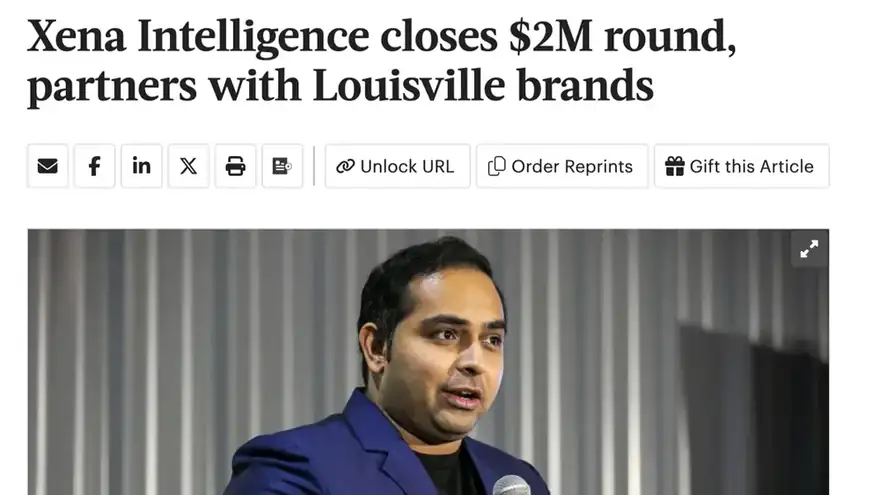
And I have thought about this a lot over the past few years, especially while building Xena, and I have come to a conclusion that feels both obvious and difficult to fully internalize at the same time, which is that the amount of VC money raised is, in many ways, a vanity metric, one that looks incredibly impressive on the outside and opens doors that would otherwise remain closed, but does not necessarily reflect the depth of value being created underneath.
Because raising money is potential.
Creating value is proof.
And those two things, while related, are very far from being the same.
When I look back at the journey of building Xena, I do feel proud of the capital we have raised, not because it looks good on a slide or because it gives us some sort of external validation, but because it represents belief from people who chose to trust us at different stages of uncertainty, often when there was very little beyond conviction, a few early signals, and a lot of hard work happening quietly behind the scenes.
But if I am being completely honest, the thing that gives me a far deeper sense of pride, the kind that actually stays with you long after the excitement of a funding announcement fades away, is the value we have been able to create for the ecosystem around us, the customers who rely on us, the partners who build alongside us, and the people who have somehow become a part of this journey without any obligation to do so.
I still remember the early days very clearly, when Xena was not even close to what it is today, when there was no structured product, no polished narrative, and definitely no credibility to lean on, just a belief that e-commerce brands were operating in a world that was far more complex than it needed to be, and that there had to be a better way to give them clarity.
I remember sitting in small cafes around Boston during my time at Babson College, reaching out to local businesses in Wellesley, trying to convince them to let me manage their Amazon listings, often getting ignored, sometimes getting polite rejections, and occasionally getting a meeting that would either go nowhere or turn into a small opportunity that I would hold onto like it was the most important deal in the world.
There was one particular instance that has stayed with me, where I had spent days preparing for a conversation with a small business owner, going through their listings, identifying issues, thinking through how I would present the value, and when I finally got on the call, I realized halfway through that they were not even remotely convinced that Amazon was worth their time, let alone that I could help them succeed on it, and I remember finishing that call feeling like I had completely failed to communicate something that I deeply believed in.
At that point, there was no funding, no safety net, no guarantee that any of this would work out, just a growing list of attempts, some small wins, and a lot of learning happening in real time.
And yet, even in those moments, people showed up.
I remember one of our early customers who took a chance on us when we had very little to show, no fancy dashboards, no automated systems, just a willingness to work harder than anyone else to make things work, and I remember how seriously I took that responsibility, because when someone trusts you at that stage, it is not just a business decision, it is a personal bet.
That customer is still with us.
And that means more to me than any number on a funding announcement ever could.
As Xena started growing, as we began working with larger brands, as we built out more structured systems and started seeing real traction, there were moments that felt like validation, but even then, the journey never felt linear or easy.
I remember working with brands where we had to deal with listing suppressions, fake reviews, hijackers, things that most people outside of e-commerce never even think about, and spending hours, sometimes days, just trying to fix issues that should not have existed in the first place, and yet knowing that solving those problems was exactly what our customers needed from us.
I remember moments where we would push changes to listings or ad strategies and see nothing happen immediately, and having to stay patient while continuing to iterate, trusting that the underlying logic would eventually translate into results.
And then I remember the moments when it finally did.
When a product that was struggling suddenly started gaining traction. When a brand that felt lost started understanding their data in a completely new way. When a founder told me that for the first time, they felt like they were not guessing anymore.
Because as a recent immigrant and a first time founder, I did not come into this with a built in network, I did not have a long list of investors I could call, I did not have a predefined path that I was following, I was figuring things out step by step, often learning things the hard way, and constantly questioning whether I was making the right decisions.
And yet, despite all of that uncertainty, people believed.
Not always because everything was perfect or fully figured out, but because they saw something worth supporting.
I have had mentors spend hours with me, breaking down ideas, challenging my assumptions, and helping me think more clearly.
I have had investors take meetings with me when I had very little beyond conviction and a story that was still evolving.
I have had team members join at stages where stability was not guaranteed, choosing to be a part of something that was still being built.
I have had friends and well wishers reach out at the exact moments when I needed it the most, often without even knowing how much it mattered.
And I do not take any of that lightly.
Because that kind of support is not transactional.
It is not driven by immediate upside.
It is given because people choose to believe.
And when you are a recent immigrant trying to build something from scratch in a new country, that belief carries a weight that is hard to fully put into words.
There is a certain loneliness that comes with building something in an environment where you are still finding your footing, where you are learning not just how to build a company, but how to navigate an entirely new system, and in those moments, the kindness and support of others becomes something you hold onto very tightly.
So yes, while I understand why VC money is celebrated, and while I am grateful for the belief that investors have shown in us, I find myself caring far more about a different set of things.
I care about the brands that trust us with their growth.
I care about the people who have chosen to be a part of this journey.
I care about the ecosystem that continues to grow around Xena, one relationship at a time.
I care about the value we create when no one is watching.
Because at the end of the day, long after the numbers change, the rounds get announced, and the attention shifts elsewhere, what actually remains is the impact you have had on people.
And when I think about that, when I think about the customers, the team, the mentors, the partners, the friends, and everyone who has played even a small role in this journey, I feel an overwhelming sense of gratitude.
Not because everything has been easy.
But because none of it had to happen the way it did.
And yet, somehow, it did.
And that, more than anything else, is what I am truly proud of.
To infinity and beyond
Akhil
Get the next entry. Founder's Diary lands on LinkedIn first. Behind-the-scenes moments go on Instagram.