I Already Said It. In My Head.
 By Akhil Suresh NairFounder & CEO, Xena Intelligence · 1,445 words
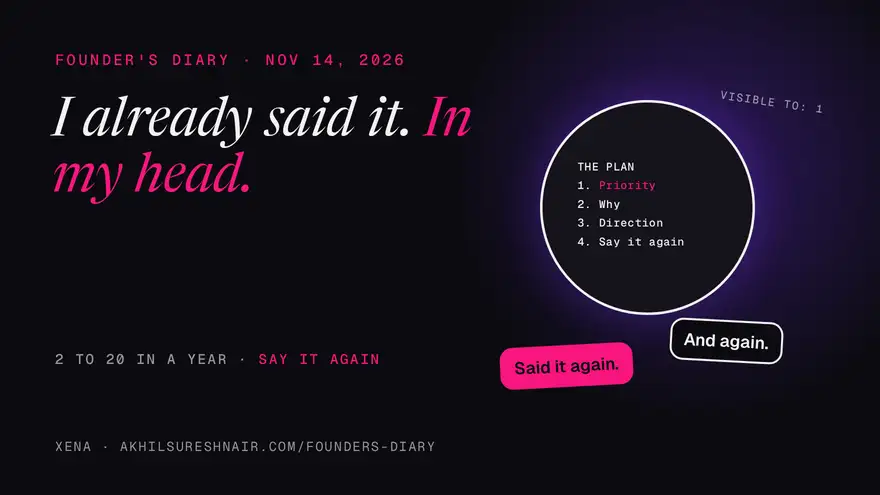
For a few years I ran Xena on a plan that was very clear, very well organized, and stored entirely in my head.
It was a good plan. I thought about it on walks around Louisville. I thought about it in the shower, in line for coffee and, on a bad night, at 2am. By the time I got to a team call, I had been over it so many times that saying it out loud felt redundant. Surely everyone knew. I had mentioned it once. Possibly twice. One of those times may have been to Sana, who does not work at Xena.
Last November I wrote a short LinkedIn post that opened with "Overcommunicate at your startup." The second line was "Your team cannot read your mind." Founders agreed with it in the comments, which is easy to do in the comments. What I didn't put in the post is that I wrote it because, for a while, I assumed my team could.
Your team cannot read your mind.
Two people, then twenty
When Xena was two people, this was not a problem I had. It is hard to under-communicate with one other person. You are both looking at the same screen. The whole company fits in one conversation, and it is usually the same conversation you have been having since breakfast.
Then in 2022 we went from 2 to 20 in a year. I posted about it at the time with a line I still mean: I'm surrounded by people considerably more smart and skilled than I am. That was true then. It is more true now, and I have stopped checking.

What I didn't account for is that twenty smart people still can't see inside one head. Xena was growing fast, and everything felt like it was moving at the speed of light. In my head the priorities were obvious and the direction was straightforward. In reality, each person on the team saw a few pieces of what I saw, and they were trying to build the full picture from fragments.
That is how misalignment starts. Nobody was doing a bad job. They were doing a very good job on the version of the plan they could see, which was not always the version I was carrying around. The gap between those two versions was my fault, and it took me an embarrassingly long time to notice that the person who could close it was also me.
The job description is a draft
Part of the problem, and I mean this as an explanation and not a defense, is that my own job kept changing.
About a week before that post I wrote another one, about how a founder's job changes every single week, without notice. One week you're the chief salesperson, pitching anyone who will take the call. The next week you're the HR department, figuring out benefits and hiring. Then you're the finance team, staring at a spreadsheet, calculating runway and wondering whether the SaaS subscription you forgot to cancel is still charging you. It is. It always is.
My job title, according to my calendar
- Sales weekChief salespersonPitching anyone who will take the call.
- HR weekThe HR departmentBenefits, hiring, and whether someone fits.
- Finance weekThe finance teamRunway math and one forgotten SaaS subscription.
- Data weekThe analystDeep in numbers. Very happy, briefly.
- Most other weeksThe firefighterSmall urgent fires, before they become large urgent fires.
The roles are from my LinkedIn post of November 2025. The order changes without notice.
When I started Xena, this frustrated me. I wanted stability. I wanted a clear description of my job so I could do it well. Startups do not care what you would like your job to be. They care whether you get the company through the week.
What I didn't see for a long time is how this connects to the mind-reading problem. Each week I made decisions with that week's context. In finance week I decided something about spending. In sales week I told a customer what we would do for them. Every decision made complete sense to me, because I was carrying all the weeks around at once. The team saw each decision on its own, without the weeks of thinking behind it. From where they sat, I imagine some of my calls looked a bit like weather.
Saying it again, on purpose
I used to think repeating myself meant I was a bad communicator. If I explained it well the first time, why say it again? Saying the plan a second time felt like admitting the first explanation was weak. Saying it a fifth time felt like a personality problem.
What I noticed at Xena went the other way. The more I repeated the plan, the more confident the team became. The repetition itself was never the point. It removed a kind of invisible friction. When people know why a decision was made, they take ownership of it. When they know where we're going, they move faster. When they know what matters most this month, they stop spending energy on what doesn't.
Where a priority used to get said
IllustrativeHow it felt before I fixed it. I never counted, which was part of the problem.
The feeling on my side never changes. By the fifth time I say something, I am tired of hearing it. I assume I sound like a song stuck on repeat. That is usually right around when it starts to land for people who weren't inside my head for the previous month. As founders, we think we're being repetitive. Meanwhile, the team is only now getting clarity.
The bar I use now came from the same post. Say it until the team can repeat it when you're not in the room. If I disappeared for a week and someone asked what Xena cares about most this quarter, the answer should come out the same from everyone. When it doesn't, I haven't said it enough. That test is not kind to my ego. It has been very kind to the company.
The answer in the coffee line
There is another post of mine, from September 2025, that belongs in this story. It is short. It says you can brute force a problem for 100 hours straight, feel like you're going in circles, and then one random night, on a late walk or in line for coffee, the answer clicks in 10 seconds.
I still believe that. But it has a side effect I didn't write about. When the answer clicks on a walk, I am the only person on the walk. I come back with a fully formed idea and an energy level that does not match anyone else's Tuesday afternoon. The team wasn't on the walk. They didn't feel anything click. From their side, a new direction just showed up in a message with no context, sent by a man who seems unusually excited.
So part of the job now is walking people back through the 100 hours. What I tried and why it failed, and then why I think this one might work. It takes longer than sending the message. It also saves everyone a week of politely building the wrong thing.
Things I can actually count
From my own LinkedIn posts.
Two products, same habit
This matters more now than it did in 2022. A lot of my week goes into SearchPanel, which tracks how brands show up when people ask ChatGPT, Gemini, Perplexity and Google's AI Overviews what to buy. In October my engineering team built it in record time, and I wrote that speed covers up a lot of mistakes. I still think so. Speed does not cover up a team that isn't sure why it is sprinting.
With two products moving at once, the context gap gets wider. Something obvious to me about Xena isn't automatically obvious to someone deep in SearchPanel work, and the other way around. So I say the plan again, and I say why again. I write it down where people will actually see it, and then I say it in the meeting anyway, because written down and heard are two different things.
None of this is a framework. It is mostly me getting used to the sound of my own voice saying the same sentence on Monday that I said the Monday before. I've made my peace with it. The team, as far as I can tell, has made peace with it too, or they are very polite.
A cheap test
If you run a team of any size, try this one. Ask a few people, without warning, what matters most this month. If the answers don't match, the team is fine. You just haven't said it enough yet. I know because I've failed that test, and the fix was not glamorous. I said it again.
I write longer versions of these notes in my Founder's Diary newsletter on LinkedIn (opens in a new tab), which is one more place where I repeat myself on purpose. Instagram, at @akhilsuresh (opens in a new tab), is mostly family, who have never once needed me to explain the plan twice. And if you run a consumer brand and want to know what AI assistants are saying about your products, my calendar is open at meeting.akhilsureshnair.com (opens in a new tab). I'll explain how SearchPanel works. Then, probably, I'll explain it again.
Newsletter
Notes from Akhil
Occasional notes on building Xena Intelligence and SearchPanel from Louisville: what's working, what isn't, and what I'm learning.
Get the next entry. Founder's Diary lands on LinkedIn first. Behind-the-scenes moments go on Instagram.