Editor, Unopposed
 By Akhil Suresh NairFounder & CEO, Xena Intelligence · 1,621 words
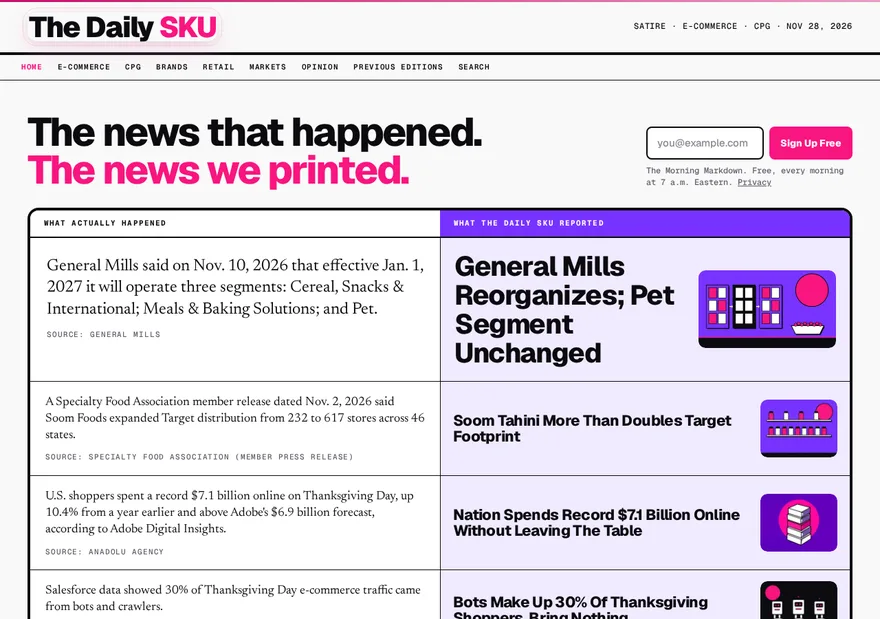
At 7 a.m. this morning, a newspaper I run published a story headlined "Bots Make Up 30% Of Thanksgiving Shoppers, Bring Nothing."
The headline is a joke. The number isn't. MediaPost reported yesterday that Salesforce data showed 30% of Thanksgiving Day e-commerce traffic came from bots and crawlers, and the story says so in a box at the bottom, with a link to the reporting. A few rows down, the paper reported that the nation spent a record $7.1 billion online "Without Leaving The Table." That's Adobe's figure, up 10.4% from last year. It also happened.
The paper is called The Daily SKU. Today's edition is Vol. I, No. 38. The masthead lists the price as One Attention Span, and the weather report is always for Bentonville. This morning's forecast was "Calmer Aisles, Scattered Returns."
The first edition came out on October 23. I haven't written about it here, partly because I wasn't sure it would last a month, and partly because explaining why the CEO of an AI company for consumer brands started a fake newspaper takes more than one sentence. This is the longer version.
One of the largest, one of the smallest
Before Babson and before Xena, I worked at HT Media, one of India's largest media companies. I managed the expansion of its FM radio studios and built its e-commerce operation. Everyone around me knew far more about the news business than I did. What I mostly took away was that a newspaper has to come out every day, whether or not anyone feels inspired that morning.
When I announced The Daily SKU on LinkedIn, I wrote that I used to work for one of the largest media houses in the world, and now I run one of the smallest. The editorial meetings are shorter. That is still the most accurate thing I've said about it.
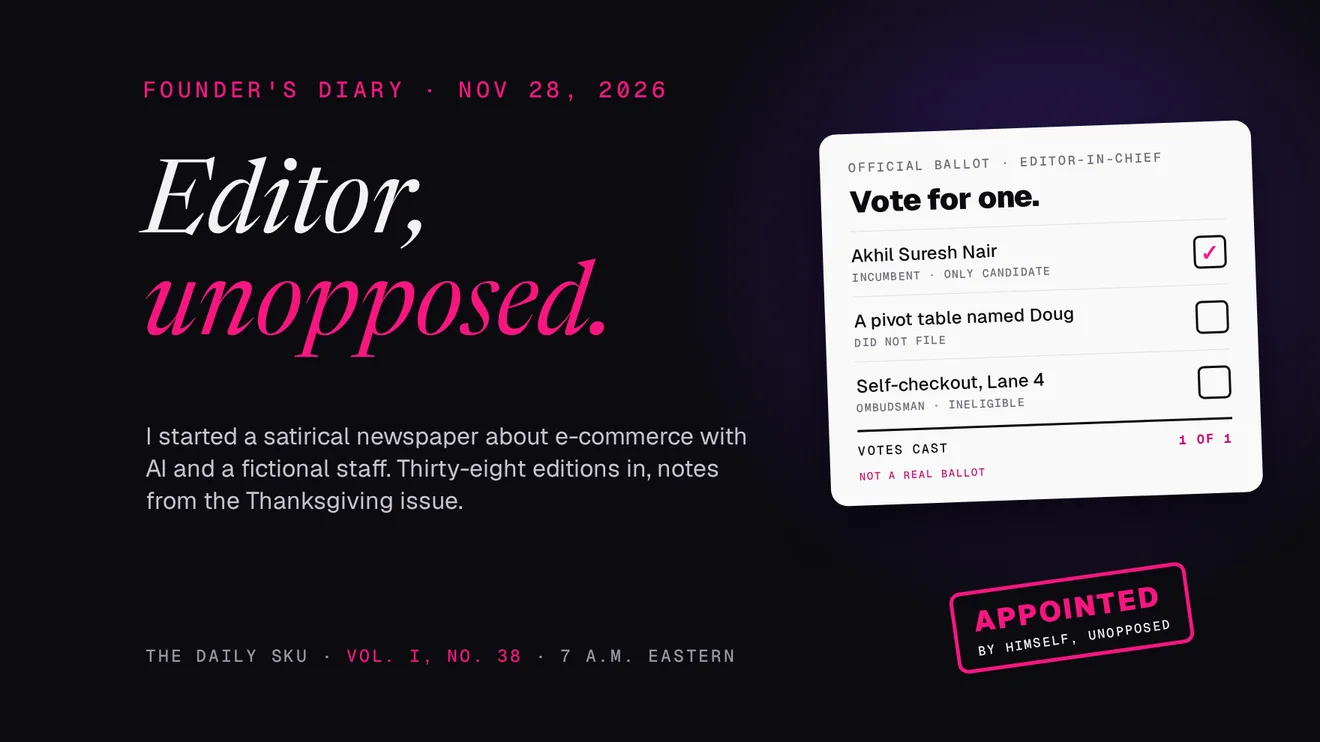
The staff is fictional, and the paper says so on every page. There are six reporters. Celeste Abernathy covers CPG and weighs everything on a kitchen scale named Judge. Priya Venkataraman-Lutz covers AI agents and cannot get her own agent, Gerald, to stop buying her things. The columnists include a 34-gallon steel shopping cart from Tulsa, a five-star review of a garlic press, and a coupon for 75 cents off two, who expires Sunday and has made his peace with it. The Chief Data Officer is a pivot table named Doug. The ombudsman is the self-checkout in Lane 4.
None of them has asked for a raise. Doug has never once asked what the plan is.
The Daily SKU, so far
From thedailysku.com (front page, Previous Editions and Staff pages, Nov 28, 2026) and my LinkedIn post of Nov 6, 2026.
Why a newspaper
The short answer is in the post where I announced it. As a founder, I feel an urge to build something new every day, and this year the tools caught up with the urge. Claude, Grok, Muse and Codex have cut the time from idea to working version to almost nothing. I wrote that this removed the last thing protecting me from my ideas. I meant it as a joke, mostly.
The paper is heavily inspired by The Onion. My market research was that I would personally read it. That was the entire process. I've sat through enough investor feedback to know nobody would accept that as a process, so I didn't ask anyone to.
What I underestimated is how much of the work is still mine. Every day I decide which headlines and stories run the next morning. A machine can produce a hundred jokes about shrinkflation before my coffee is ready. Picking the one that someone who runs a snack brand will forward to their team is a different job, and it hasn't gotten any faster.
You can't prompt your way to knowing an industry. You still have to do it the old way, by sitting through it.
I've sat through a fair amount of it: years of Amazon ad campaigns, and calls with brand teams about why a product stopped showing up in search. One of the guest columnists is a product listing for a bamboo shower caddy, suppressed from search since March "for a missing attribute nobody will name." The people who laugh hardest at him are the ones who have spent a week hunting for that attribute. That's most of the people I work with.
The one rule
The paper has a lot of rules about tone, and one I care about more than the rest. No real person's words are made up. Real companies appear because real companies do real things, but every spokesperson, analyst and survey quoted in a story is invented. Every story ends with a box called The Real Story, which says what actually happened and links to whoever reported it.
The About page puts it better than I would. If a headline seems too absurd to be true, that's because we made it up. If it seems too absurd to be made up, check The Real Story.
There's a second rule next to it. The paper punches at corporate absurdity, not at shoppers or workers. That one matters to me for a practical reason. I sell to brands, and I'd like to keep sitting across the table from them.
This diary runs on the first rule too, minus the jokes in the headlines. Everything in it has to be something that happened, or something I've said in public. It is a little funny that the most carefully sourced thing I publish every day is the fake newspaper.
How a Daily SKU story gets made
- The newsSomething a company actually didAn announcement, an earnings call or a study, with a source.
- The deadpanWritten as if everyone is exactly as serious as they claimThe joke lives in the headline and the invented details.
- The Real Story YesThe fact, stated plainly, at the bottomWith a "Riffing on" link to the original reporting.
- 7 a.m. EasternThe edition goes outOn the site and in The Morning Markdown, the free daily email.
From The Daily SKU's About page and story format, Nov 2026.
Thanksgiving week in the newsroom
Holiday weeks are good for a paper like this, because retail announces its numbers the way relatives announce things at dinner, loudly and with no context.
Thursday's lead was "Nation Puts Thanksgiving Pie On Four Interest-Free Payments." Adobe had said buy now, pay later spending hit $6.1 billion this month. The final slice of pumpkin, the paper reported, is due February 18.
Friday's was Kroger, which is cutting about 3,000 corporate jobs, under the headline "Kroger Cuts Office Jobs To Improve The Shopping Experience." The paper noted that the improvement is expected in the aisles, where no corporate employees work.
Today's lead is General Mills, which said on November 10 that from January 1 it will run three segments, one of which is Pet. The headline: "General Mills Reorganizes; Pet Segment Unchanged." I'd argue the paper's main contribution there was noticing.
That's the part I didn't expect when I started. I wrote in November that some days the news has already done most of the work. The holiday season has been very generous on that front.
Stories filed at The Daily SKU, by fictional staffer
Story counts from the Staff page on thedailysku.com, Nov 28, 2026. None of these people exist. Neither does the cart.
The retail correspondent leads the CPG reporter by one story, which makes it the closest race at the paper. The race for editor was less close. I appointed myself, unopposed.
Most of my coworkers are not people
The newspaper is the funny version of how Xena works now. A few weeks ago I posted that I run a startup where most of my coworkers are not people. We have sixteen humans, in Louisville, Dubai and Kochi, and hundreds of AI agents running at any given moment. They pull client reports, watch how brands show up, and email me when someone signs up for a newsletter at 1 a.m.
One Sunday I woke up to an email from my own address. Twenty-two new sign-ups overnight, one flagged as likely spam, and a note that two publications were still missing from a data sync. Being reported to by yourself is an odd way to start a weekend.
The main thing I've learned from both places is the same. A person who is stuck tells you. An agent that is stuck produces something plausible. So at Xena we build agents whose only job is to doubt the other agents. The newspaper has the same problem in a funnier costume. A machine will happily write a Real Story box that sounds right, and somebody still has to click the link.
The people on my team did not end up with less to do. Nobody downloads CSVs anymore. They read holiday growth plans, argue about FBM versus FBA for a client, and get on calls with founders. What's left is judgment, which is also what an editor does all day, with fewer puns.
Small Business Saturday
Today is Small Business Saturday, which American Express started in 2010 to get people shopping at small businesses the day after Black Friday. A lot of what Xena does is help small and mid-sized brands sell more on Amazon and Walmart, so this weekend matters to the people we work for more than most weekends do.
The Daily SKU is a small business too, in the loosest sense of both words. It's free. The only business model I can find on the page is a line at the bottom saying it earns from qualifying Amazon purchases. I have pitched in a lot of rooms, and I can't think of one that would fund that.
What it does have is readers who recognize their own jobs in it, usually with some discomfort. They aren't a large group, and I worry about them. They're also the ones who passed it along, which is how most small businesses I know found their first customers.
I don't know how long a volume lasts at The Daily SKU. Nobody has told me, and I'm the only one who could. For now, No. 39 goes out tomorrow at 7 a.m. Eastern, and as far as I know, the Pet segment is still unchanged.
The real version of my week goes out in my Founder's Diary newsletter on LinkedIn (opens in a new tab), and the family side ends up on Instagram at @akhilsuresh (opens in a new tab). If you run a brand and want to talk about how you show up on Amazon or in AI answers, you can find time with me at meeting.akhilsureshnair.com (opens in a new tab). And the paper is at thedailysku.com (opens in a new tab), if you have One Attention Span to spare.
Akhil
Newsletter
Notes from Akhil
Occasional notes on building Xena Intelligence and SearchPanel from Louisville: what's working, what isn't, and what I'm learning.
Get the next entry. Founder's Diary lands on LinkedIn first. Behind-the-scenes moments go on Instagram.