A Paddle Almost Her Size
 By Akhil Suresh NairFounder & CEO, Xena Intelligence · 1,340 words
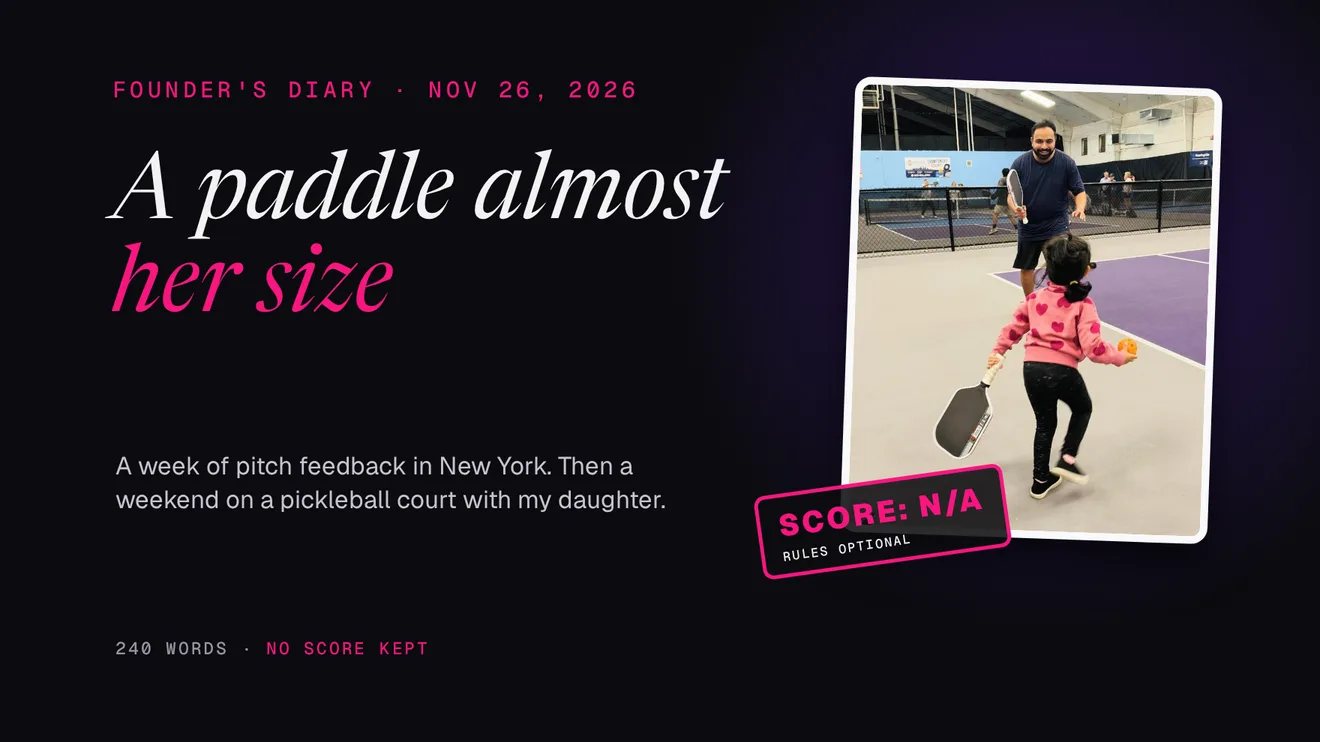
The paddle is almost as tall as she is. That's the first thing you notice in the photo. The second is the orange ball in her other hand, which she is holding like she has no plans to ever let it go.
That was Kiara, my daughter, on an indoor pickleball court the weekend after I got back from New York. She picked up the paddle, decided I was the target, and came running. She did not serve. She did not wait for me to be ready. As far as I could tell, the plan was to arrive.
I posted the photo on LinkedIn the Monday after, with a few lines about it. I've thought about those few lines more than about anything else from that week, which is a little awkward, because the week was supposed to be the educational part.
The week
Xena is in the 2026 cohort of Morgan Stanley Inclusive & Sustainable Ventures. Morgan Stanley picked 24 organizations, 20 startups and four nonprofits, out of what their announcement calls thousands of applications. Each startup gets a $150,000 equity investment and a five-month program, and in February 2027 the whole cohort presents at a demo day. Xena is listed under Economic Empowerment, with a one-line description about helping brands show up in AI-generated recommendations. It's a cleaner one-liner than some of mine.
The 2026 MSISV cohort, by the numbers
From Morgan Stanley's announcement of the 2026 cohort, Sep 14, 2026. Demo day is in February 2027.
In September, for the same program, my face was on a Nasdaq screen in Times Square, next to Xena's logo in pink letters. That was the glamorous part of being in a cohort. The New York week in November was the other part.
Fall 2026, the MSISV part
- Sep 14Cohort announced24 organizations, picked from thousands of applications.
- Sep 17Times SquareMy face on a Nasdaq screen, next to Xena's logo in pink letters.
- Week of Nov 9New YorkA lot of pitching, a lot of feedback.
- Fri, Nov 13HomeBack from New York, still rewriting the pitch in my head.
- That weekend YesThe courtOne paddle, almost her size. No score.
- Feb 2027Demo dayThe whole cohort presents at demo day.
Dates from Morgan Stanley's Sep 14, 2026 announcement and my LinkedIn posts of Sep 17 and Nov 16, 2026.
It was a lot of pitching and a lot of feedback. There were sessions on negotiation and on fundraising. There were also sessions on how to tell the story of your company, which is a subject I have opinions about, because I've been telling mine to strangers for about five years and I still edit it in the shower.
I'm not going to repeat anyone's notes here. They were given in a room, and they can stay in the room. What I can tell you is what a week of feedback does to my pitch, because it does the same thing every time.
What a week of notes does to 240 words
I write my two-minute pitches at about 240 words. Under stage lights I talk faster than I think I do, so I leave the leftover seconds for breathing, which I've found helps. Every one of those 240 words has been argued over, by me, alone, usually out loud, often in a hotel bathroom.
Then I spend a week somewhere with smart, generous people, and every smart, generous person has one more thing they'd like to hear. Usually it's one more number, or a customer example. Each note is reasonable on its own. Very few of them arrive with a matching suggestion about what to take out. I'm still waiting for the person who says, loved it, could you say a little less about the market.
My two-minute pitch, if I said yes to every note
IllustrativeMade-up notes and rough word counts, to show the math. The 240-word limit is my real rule for a two-minute pitch.
Most people speak somewhere around 130 to 150 words a minute. At that pace, 375 words takes a good two and a half minutes. In a two-minute pitch, the extra half minute is where the timer starts flashing at you and the judge puts down the pen.
So the real work after a week like that is choosing which notes win, and then cutting something I like to make room for each one. All week I'd been doing that in my head. How to say it better, what to cut, what investors want to hear. I wrote exactly that in the post. Then the weekend happened.
No score
In the post I said she didn't care about the rules or the score. I meant it literally. I'm not sure she knows there is a score. She knows there's a ball, and a dad, and the paddle is how you get from one to the other.
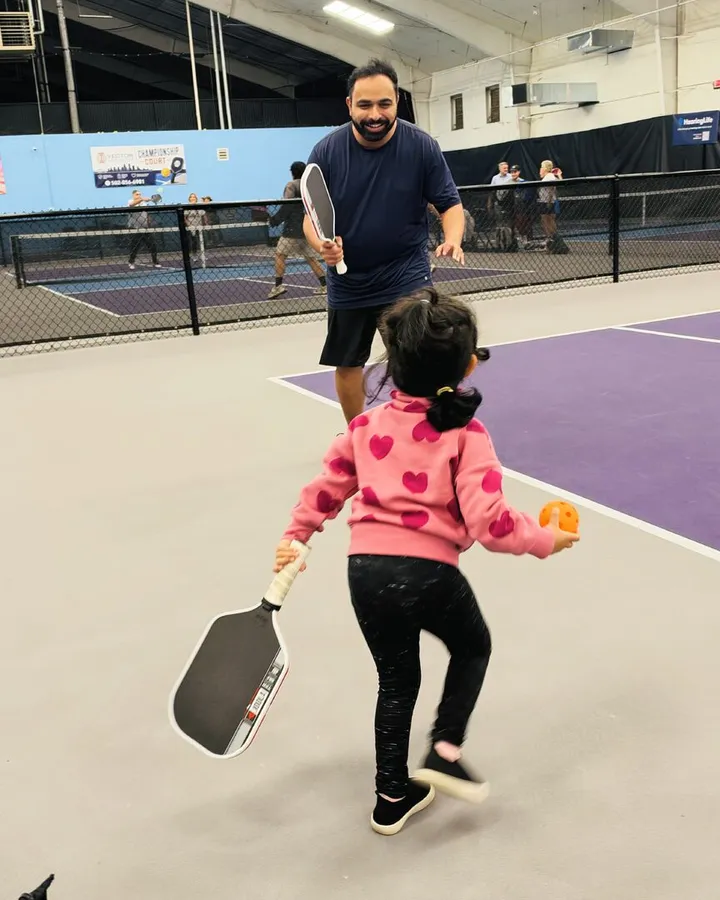
Everything about my week had been scored. That's what pitching is. I've done more than 40 pitch competitions, and every one of them had a judge with a pen and a clock that had no interest in my stage fright. Venture Atlanta put me in slot 27 out of 28. RALLY gave me two minutes with up to $1M on the line. Even the friendly rooms keep score. They just write it on their faces instead of on paper.
And then a small person with a paddle came at me and had the best time of anybody on that court, without knowing the rules at all.
She reminded me that half of it is just showing up excited about what you're doing.
I want to be careful with that sentence, because it's the kind of thing that looks great on a poster and does nothing for you in a diligence call. Excitement doesn't replace the numbers. Nestlé did not renew with us for 24 months because I seemed cheerful.
What I have noticed about my own pitches is that the editing has a cost nobody puts on the scorecard. Every time I cut a sentence I love to make room for a sentence somebody asked for, the pitch gets more correct and a little less mine. By the end of a feedback week I can sound like a very well-prepared person presenting someone else's company.
The stage fright makes it worse. My way of handling it is to rehearse the first 20 seconds ten times more than everything else, so I can say them while panicking, because I will be panicking. That works. It also means that by the time I'm up there, the most rehearsed part of me is the least excited part, because it has heard those 20 seconds more times than I'd like to count.
In September I wrote that I never entered a single pitch competition expecting to win. I went into every one of them thinking "let's see what happens," which I described as ambition wearing a fake mustache so rejection won't recognize it. I meant it as a confession about underestimating myself. Watching Kiara with that paddle, I think the fake mustache might also have helped. "Let's see what happens" is exactly how she plays. I doubt anyone will ever have to tell her to sound more excited.
The 53 bots
A few people commented on the post. One of them was Dr. Michael Barnes, who runs Viva Benefits, another company in the cohort. He wrote that they'd learned a lot from me too, "and your 53 bots!" He also mentioned that his daughter, who is nine, loves pickleball. So there are at least two founders in this cohort who spend weekends getting chased around a court by someone a lot shorter.
I'll explain the 53 bots another time. For now I'll say that none of them have ever come running at me with a paddle, and none of them fixed my pitch as fast as she did. My best ideas tend to show up that way. I can spend a hundred hours on a problem, and then the answer turns up in about ten seconds while I'm doing something else. This time the something else was pickleball, and the answer was two years old.
Today is Thanksgiving. Nobody is pitching anybody today, which makes it the one day this month my pitch is safe from me.
Demo day is in February, so the 240 words will get argued over again before then. They always do. I'd just like at least one sentence to make it through that I put there because I was excited, and not because anybody asked for it.
Kiara, for the record, has never asked me who won.
Longer versions of these go out in my Founder's Diary newsletter on LinkedIn (opens in a new tab). The pickleball photos, and most of the family ones, end up on Instagram at @akhilsuresh (opens in a new tab). And if you run a brand and want to talk about how you show up on Amazon, Walmart or in AI answers, you can find time with me at meeting.akhilsureshnair.com (opens in a new tab). I'll keep my part to two minutes.
With love,
Akhil
Newsletter
Notes from Akhil
Occasional notes on building Xena Intelligence and SearchPanel from Louisville: what's working, what isn't, and what I'm learning.
Get the next entry. Founder's Diary lands on LinkedIn first. Behind-the-scenes moments go on Instagram.