Would It Make the Deck?
 By Akhil Suresh NairFounder & CEO, Xena Intelligence · 1,458 words
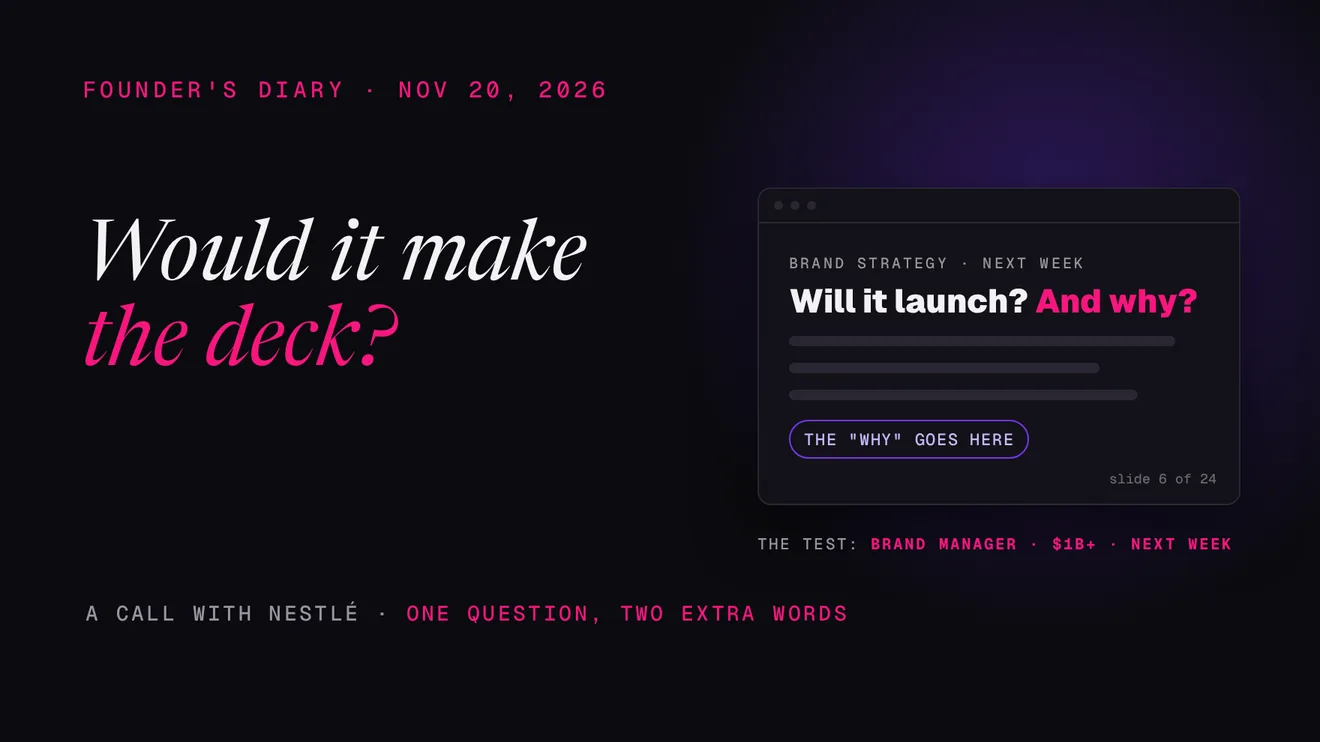
Every new thing we build at Xena has to answer one question before anyone writes code for it. Would a brand manager at a $1B+ company actually use this in a deck next week?
I wrote that sentence in a LinkedIn post in July 2025. I would like to tell you it came out of an offsite, with a whiteboard and those little sticky notes that never stay stuck. It came out of a call with a team at Nestlé, and the main thing that call taught me was that my definition of customer-obsessed had been mostly about me.
Would a brand manager at a $1B+ company actually use this in a deck next week?
How we got on the call
Nestlé first turned up in my inbox in 2020. I was sending cold emails to strangers, hundreds of them, and somebody there replied. I've written about that email before, so I'll skip it. This post is about a later part that I haven't written much about, which is what happens after a very large company says yes and then keeps asking you questions.
A few months before that July post, I was on a call with a team at Nestlé. Smart folks. Deep in the weeds. If you had asked me beforehand what they'd want to hear about, I would have said the technology, because that is what founders come ready to talk about. We practice it. We have slides for it.
They were not interested in our tech stack. They were not interested in how "AI-powered" anything was. What they wanted to know was this:
"Can Xenalytics tell us if our new product brand would successfully launch in the online marketplaces, and why?"
I have thought about the last two words of that question more than I've thought about some of my own pitch decks.
The first half is a forecast. Will this launch work? Lots of people and plenty of software will give you a forecast. Some of them are even right. The second half is harder. "And why" is the part you have to say out loud in a meeting when the person above you asks how sure you are. A forecast without a why is a guess you're asking someone else to stand behind.
That team wasn't asking for more data. They had more data than most companies on earth. They wanted a perspective, backed by a huge amount of data, that they could carry into their next brand strategy meeting and say, as I put it in the post, "Here's what we're seeing. Here's where the white space is. Here's what to do next."
Notice who is talking in that sentence. It isn't me.
Founder-obsessed
Before that call, I thought I knew what customer-obsessed meant. Listen to feedback. Build fast. Ship faster.
In the July post I wrote that this turns out to be founder-obsessed with your own roadmap. That's still the line from the post I'd keep if I could only keep one.
Here is what I meant. Listening to feedback and shipping fast sounds like the customer is driving. But I was the one who decided what the feedback meant. I picked the order. I decided what "fast" was for. The customer said something on a call, and by the time it reached the roadmap it had been translated into something I already wanted to build. That isn't a crime. It's just a different thing from what I thought I was doing.
The irony is that I had been preaching the customer's point of view for years. In the early days of Xena I would sit in front of e-commerce dashboards late at night, scrolling search data and reviews, trying to understand why so many consumer brands made big decisions with so little visibility into what their customers were thinking. I used to tell brands that Amazon isn't simply a revenue channel. It is the largest real-time focus group on the planet. It tells you what people want, what they compare you against, what annoys them, and what they search for and can't find.
Some people saw that right away. Others thought I was overanalyzing something that just needed better ads.
So I understood the focus group. What the Nestlé team showed me was that I had been presenting the focus group's results in a way only I could read. They needed something they could take into a room without me in it.
Taking my own sentence apart
I like the test because every phrase in it does a job. Here is how I read it now.
The deck test, one phrase at a time
- A brand managerWho uses itThe person who does the work and has to defend it. Not the CEO, and definitely not me.
- at a $1B+ companyWhereSomeone with more data than time, and several people above them who will ask "and why?"
- in a deckHow it travelsIt has to survive being copied onto a slide, in someone else's words, with me nowhere near the room.
- next weekWhenNot next quarter, after a training session and a kickoff call.
My reading of the sentence from my July 2025 LinkedIn post.
"A brand manager" rules out the people I usually picture when I build. I picture the person who signs the contract, or worse, I picture myself on a demo, clicking through the good parts. The brand manager is the one who has to use it on a Wednesday.
"At a $1B+ company" is about scrutiny. At that size a slide gets looked at by a lot of people, and at least one of them has been in the industry longer than Xena has existed. If an insight can't hold up there, it can't hold up.
"In a deck" is the phrase I underestimated most. My pitches are two minutes long, and I still get to deliver them myself. I can lean on tone, a pause, a bad joke. A sentence on a slide in someone else's deck gets none of that. It has to work cold, read by a stranger, possibly at 8 in the morning.
"Next week" is the honest part. Plenty of things are useful eventually. A brand manager has a meeting on Tuesday.
What we changed
That Nestlé conversation is when we went all in on a new feature inside Xenalytics, which we now call Growth Signals. It takes complicated marketplace behavior and turns it into simple, forward-looking insights: what is trending, and what looks like it's about to break out. In the post I said it was like having a cheat code for product innovation and market entry. I stand by the description. I'd just pick a phrase with fewer video game references now.
We also simplified the UX, and we changed how insights are written.
The writing part turned out to be its own job. A chart means something to the person who made it. To everyone else, it's a chart. The sentence underneath is what a brand manager actually pastes into a slide, so the sentence has to carry the why. We started treating that sentence as the product and the chart as the evidence.
Where my attention went on a new feature (how it felt)
IllustrativeHow it felt to me, not a measurement. Nobody timed this.
Over time the reports went in that direction too. Xenalytics work became about the white spaces, the emerging demand pockets, the product gaps people describe in reviews, and the early category shifts that most brands only notice after they've already lost share. Those are all things you can put on a slide and defend.
When we launched SearchPanel in late May, it scored how AI platforms describe and recommend a brand's products. Today it scores each product from 0 to 100 and ranks the fixes. A number from 0 to 100 fits on a slide. After the Nestlé call, I stopped thinking of details like that as small.
The part I still get wrong
The test doesn't make me immune to my own roadmap. I still get attached to things because I thought of them. The difference is that the sentence now gets to argue with me, and it usually wins.
It's also changed what I listen for on calls. I used to hear a request and start designing. Now I try to find the meeting behind it. Who is this person presenting to, and what will they be asked when they do? Those questions are less fun than designing, and much more useful.
Xena and Nestlé, by my own public count
From my LinkedIn posts and my Founder's Diary newsletter. The renewal is from my newsletter on crossing 100 customers.
Nestlé renewed with us for 24 months. I'd like to think the deck test had something to do with it. I can't prove that, so I'll just keep thinking it.
In April, when Xena crossed 100 customers, I wrote a thank-you list. One line in it was to every category manager at Nestlé who took our call. It probably read like a polite line in a long list. I meant it more specifically than that.
At the end of the July post I wrote that I was still grateful for the opportunity, and still building for that clarity. Both are still true. The second one takes longer.
If you're a brand manager and you have a question that ends in "and why," I'd like to hear it, even if Xena isn't the answer. My calendar is at meeting.akhilsureshnair.com (opens in a new tab). I write the longer versions of these in my Founder's Diary newsletter on LinkedIn (opens in a new tab), and on Instagram at @akhilsuresh (opens in a new tab) I post the parts of the week that have no slides in them. There are a few.
Newsletter
Notes from Akhil
Occasional notes on building Xena Intelligence and SearchPanel from Louisville: what's working, what isn't, and what I'm learning.
Get the next entry. Founder's Diary lands on LinkedIn first. Behind-the-scenes moments go on Instagram.