My Best Post Was About Hot Honey
 By Akhil Suresh NairFounder & CEO, Xena Intelligence · 1,231 words
I have a spreadsheet of my fifty best-performing LinkedIn posts. It's part of a content plan, which is a phrase the 2018 version of me, fresh out of Babson on a student visa, would have found very funny.
When I first looked at the list in order of impressions, I thought I knew what would be at the top. Something with a stage in it. The stage fright post, maybe. Or "From Kochi to Kentucky," which is about as personal as I get on that platform.
It was sauce.
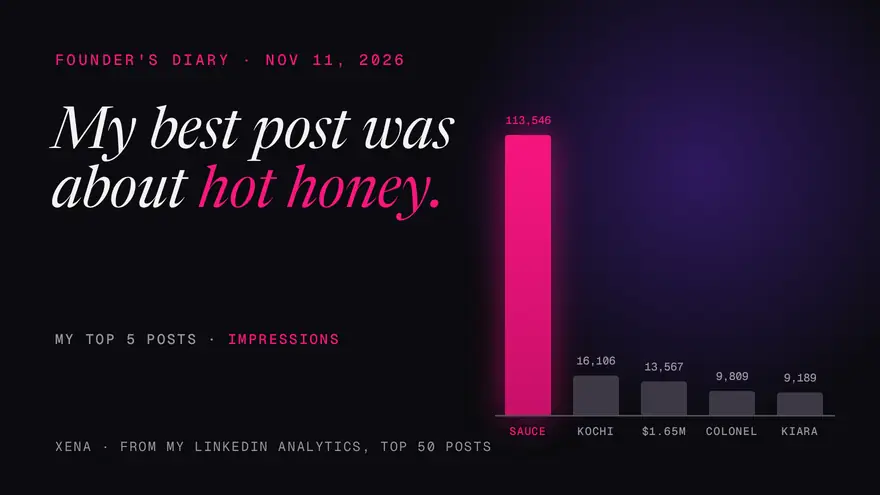
Specifically, a post from June 12, 2025, that opens with "Sauces are booming in the ecommerce space." It has 113,546 impressions. The post in second place has 16,106. My most-read piece of writing, by about seven times, is a short report on hot honey, barbecue sauce and gourmet mayonnaise.
I have written about stage fright, about leaving Kochi, about my daughter, about how lonely it gets as a solo founder. People read those politely. Then they found the aioli.
The sauce post, by the numbers
From my own LinkedIn analytics for my 50 best-performing posts.
What the post said
For anyone who missed it, which was apparently not many people in the condiment business: we had pulled together a snapshot with Xenalytics, the engine inside Xena that looks at who is actually moving product online. By then I had worked with more than twenty sauce brands, so sauce felt like home turf.
The headline was Mike's Hot Honey. In our snapshot it was doing $3.77 million in online sales, more than Frank's RedHot and Cholula, two names I had assumed were permanent features of the American refrigerator door.
Mike's Hot Honey, for example, is generating $3.77 million in online sales. That's more than legacy players like Frank's RedHot and Cholula.
Then came the seasonality. BBQ and hot sauce are crowded categories, and they peak in Q4 every single year, and a lot of brands miss that window because they aren't tracking it. Then the part I liked most, the small aioli and gourmet mayo segment, where Primal and 365 were outpacing Kraft and Stonewall by leaning hard into clean labels.
That was the whole post. No story about me. No photo of me holding anything rectangular. I show up in the very last sentence, and only to say that this is what we built Xena to do.
Ten days in June
What makes this funnier is the week around it.
On June 9, 2025, I posted that I had been commissioned as a Kentucky Colonel, the highest civilian honor the Commonwealth gives out. Three days later, I posted about sauce. A week after that, on June 19, I posted "From Kochi to Kentucky," the longer version, about growing up in Edappally and somehow ending up with the same title as Muhammad Ali and Elvis.
Ten days in June 2025
- June 9Kentucky ColonelThe commission post. 6,360 impressions, 121 comments.
- June 12Sauces are boomingThe data post. 113,546 impressions, 22 comments.
- June 19From Kochi to KentuckyThe immigrant story. 16,106 impressions, 118 comments.
Dates from the posts. Numbers from my LinkedIn analytics.
Those two Colonel posts are the most-commented posts on the whole list. 121 comments and 118. The sauce post, with about seven times the reach of the bigger one, got 22.
So in ten days I ran the cleanest experiment of my LinkedIn life, and I didn't mean to run any experiment at all. The posts about me got people talking. The post about sauce got people reading. They were mostly not the same people.
I should also point out that Colonel Sanders held the same title, and his best-known work was a recipe, not a speech about himself. I've decided to take that as a sign.
Reach and replies, my 50 best posts
The sauce postThe two Kentucky Colonel postsEverything else
That chart is the whole spreadsheet in one picture. Forty-seven posts sit in a crowd on the left. Two float at the top, where the comments are. And one is off by itself on the right, about a cooking ingredient, with almost nobody talking.
Why strangers share mayonnaise
I have thought about this more than a grown man should think about mayonnaise.
My best guess is that the sauce post was about the reader. If you run a brand, or sell to people who do, that post told you something about your own aisle. It had a winner with a name, a dollar figure, a season and an underdog. You could send it to your boss with "did you see this" and look well informed. Nobody sends my stage fright to their boss.
The personal posts work the other way around. The Colonel posts were for people who already knew me, or knew someone like me. They commented because they had something to say to me directly. A reach number can't tell me who's in my corner. A comment usually can.
The part that stings a little is that the sauce post was the best sales pitch I have ever written, and I didn't write it as one. Xena exists because brands want to know what their category is telling them before their competitors figure it out. That post was a free sample of exactly that. It reached more people than any pitch deck I have ever emailed, and the deck had my logo on every slide.
I spent years practicing how to explain Xena in two minutes on a stage. The explanation that traveled furthest took about a minute and a half to read, was mostly about hot honey, and mentioned Xena once, at the end.
My top five posts by impressions
From my own LinkedIn analytics. Titles are each post's first line, shortened.
Who did the work
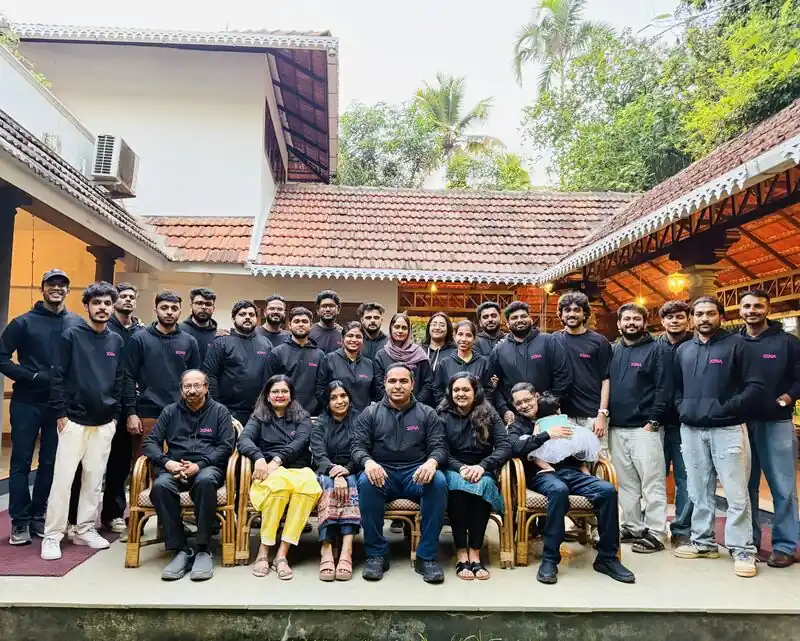
I want to be fair about where those numbers came from. The snapshot came out of Xenalytics, and the people who make Xenalytics work are my team. My part was picking the numbers I found surprising and writing them down in plain English. I got the impressions. They did the counting.
I think that's also why the post worked. Anybody can have an opinion about sauce, and on the internet most people do. The post had a count of what shoppers had actually bought, which is harder to argue with in the comments. That may explain why so few people tried.
What I'm doing about it
The spreadsheet makes a fair argument. Of my fifty best posts, exactly one is pure category data, and it's the one at the top. The best format I have is the one I have used the least. If I ran Xena's ad accounts the way I've run my own LinkedIn, a client would have fired me by now.
The obvious sequel would be a sauce post for the way people shop now, which brands ChatGPT actually recommends when someone asks for a good hot honey. That's the kind of question SearchPanel was built to answer, so I'd have no excuse. I haven't written it. I'm aware that announcing a post you haven't written yet is how most content plans end.
I'm also not going to stop writing the other kind. The Kochi post is still the one I'd hand to someone who wanted to know who I am. The sauce post is the one I'd hand to someone who wanted to know what Xena does. I need both of those people, and it turns out they read different things.
Somewhere there is a brand manager at a sauce company who knows my name only from a hot honey chart and has no idea I get stage fright. I'd like to keep it that way, so please don't tell them.
If you run a brand and want to see what your aisle looks like from the data side, or from inside ChatGPT's answers, my calendar is open at meeting.akhilsureshnair.com (opens in a new tab). The other kind of post, with lots of comments and no charts, goes in my Founder's Diary newsletter on LinkedIn (opens in a new tab). Instagram, at @akhilsuresh (opens in a new tab), is mostly family, and to my knowledge it contains no aioli.
Newsletter
Notes from Akhil
Occasional notes on building Xena Intelligence and SearchPanel from Louisville: what's working, what isn't, and what I'm learning.
Get the next entry. Founder's Diary lands on LinkedIn first. Behind-the-scenes moments go on Instagram.