Step 34 and the Gray Brick
 By Akhil Suresh NairFounder & CEO, Xena Intelligence · 1,212 words
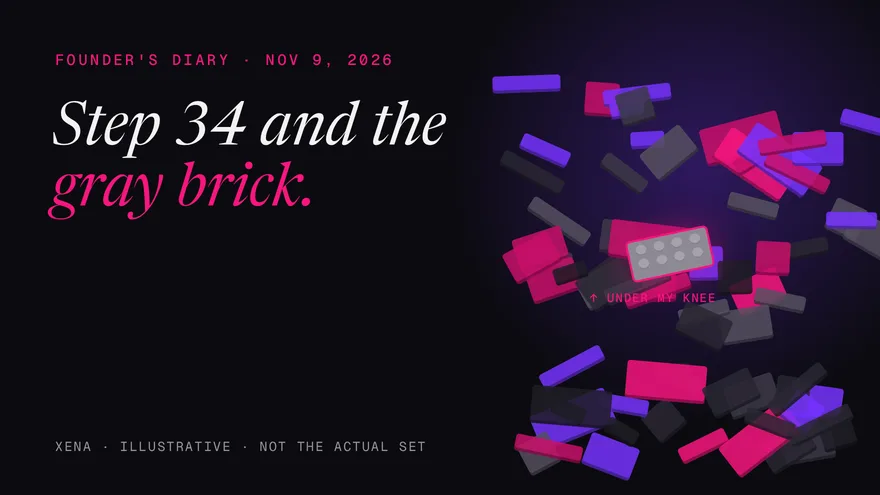
In June, Sana found me on the floor, surrounded by 3,847 tiny plastic pieces.
She asked if I was okay. I said I was decompressing.
She then listed some facts about my life. I run a company. I raise money for a living. I once stood on a stage and convinced a room full of investors to bet on me. And here I was, on the floor, beaten by a LEGO set.
I posted about it on LinkedIn the next day, because that is apparently what I do with my private humiliations now.
And here I was, defeated by step 34 of a LEGO set, because I could not find a 2x4 brick in a specific shade of gray.
I did find the brick eventually. It was under my knee the whole time.
I've been thinking about that evening more than a grown man should think about a gray brick, and today, a Monday, feels like the right day to explain why.
The only manual I get
This wasn't my first set. Last November I spent a whole weekend building a LEGO bike. It had hundreds of tiny pieces and a thick instruction booklet, and it felt good, which worried me a little.
What I loved was the booklet. Step one leads to step two. If you mess up, you go back a page and fix it. Somebody smarter than me has already worked out the order of operations, tested it, and printed it in color.
My actual job has no booklet. I said that in the post at the time, and I meant it as a complaint. Nobody hands a founder a sequence where the next piece clicks into place. Most days at Xena I'm making calls about budgets and hires and whether to send the follow-up email now or wait one more day and pretend I'm not anxious about it. None of those come with a picture of the finished thing.
So when I finally sit down to relax, my brain wants the opposite of work. It wants a problem with an answer in the back of the book.
The June evening, in numbers
From my LinkedIn post of Jun 26, 2026. The piece count is the one I posted.
Some founders relax by running ultramarathons. I respect them from a seated position. My version of an extreme sport is sorting gray pieces into piles of slightly different gray.
Every piece in the bag has a place
Here is what I didn't notice the first time, and noticed on the floor in June, probably because I had a lot of time down there.
A LEGO set doesn't come with extra ideas. Every piece in every numbered bag has a place. If you finish the bike and there's a spare wheel left over, you didn't get a bonus. You made a mistake somewhere around step 12, and you will be finding out about it.
Nobody building that bike stops halfway to add a cup holder because a friend said cup holders are nice.
That, unfortunately, is exactly how I ran Xena's product in the early days.
I was obsessed with adding features. Every new idea felt like the missing piece. A customer would make a suggestion on a call, and I'd have the team start building it that same week. One customer, one suggestion, one sprint. I thought I was being responsive. I was really being a man adding cup holders to a bicycle.
We believed more features meant more value, more usage and better retention. We shipped more and more, and usage didn't go up the way we expected. Some of our most loyal users started getting confused.
One of them asked me a question I still hear in my head when I'm about to approve something new.
"What exactly does Xena do again?"
That was a customer who liked us. That's the part that stung. A stranger asking what you do is a marketing problem. A fan asking is a you problem.
Taking pieces off
What we did next was really uncomfortable. We sat down as a team and killed features. We simplified. We said no more than we said yes.
It felt terrifying, because every one of those features had a person behind it. Somebody on the team had built it. Some customer had asked for it. Removing it felt like telling both of them they'd wasted their time, even when that wasn't true.
Then customers started getting it right away. The messaging got sharper. Demos got shorter. People stopped needing a walkthrough and saw the value in minutes.
How Xena learned to stop building
- Early daysA feature a weekOne customer suggestion, and the team started building it that same week.
- ThenUsage stayed flatWe shipped more, and some of our most loyal users got confused about what we did.
- The meetingWe killed featuresWe simplified, and said no more than we said yes.
- AfterShorter demosCustomers saw the value in minutes, without a walkthrough.
- July 2025I wrote it downEvery feature now has to earn its place.
Amrutha Killada was instrumental in getting us to the simple version. We simplified so much that we stopped saying "AI" in our demo calls. We just show what changes for the customer. Which is a slightly funny place to land for an AI company, and also one of the more useful things we figured out.
The questions I ask now
Every feature at Xena now has to earn its place. Before we build something, we ask whether it will make a material difference to a customer's return, and whether we can prove that with data. The one I care about most is the last one I wrote in that post: will users find it without us holding their hand?
If the answer to that one is no, the feature is a cup holder.
I'd like to say I learned this once and never felt the pull again. I still feel it. Someone on a call says "it would be amazing if," and the old excitement comes up, the same itch as opening a new bag of pieces. The difference now is that the next thing out of my mouth is a question about who would find it, and how.
Searching for the gray brick, how it felt
IllustrativeNot measured. I did not time myself, and I would not tell you if I had.
Under my knee
The gray brick is the part of the story I like best now, because it's the most accurate thing I've ever posted about running a company.
I spent a long time searching the room for the piece I needed, and it was under me the whole time. I was kneeling on it. That's a fairly honest description of how I've found most of the answers at Xena. The answer to "what should we build" was usually already sitting in what customers were using, and I couldn't see it because I was busy looking for the next new thing.

Still a fan of the booklet
I still don't have a manual for being a founder, and I've stopped expecting one. What the LEGO box gave me is smaller than that. It's the picture on the front. Before you open a single bag, you know what the finished thing is supposed to look like, and anything that doesn't serve that picture doesn't go in.
Most weeks, my job is to keep Xena's picture clear enough that the team can tell a cup holder when they see one. I'm better at it than I was. I'm worse at it than the people who design LEGO sets, who seem to know exactly how many pieces a bicycle needs.
And I still sit on the floor with a set when the week has been long. I recommend it, with one piece of advice from experience. Before you search the whole room, check under your knee.
If you're building something and you suspect your product has grown a few cup holders, I'm glad to look at it with you. My calendar is at meeting.akhilsureshnair.com (opens in a new tab). I write the Founder's Diary newsletter on LinkedIn, and the less polished version, which sometimes includes LEGO, is on Instagram at @akhilsuresh (opens in a new tab).
Newsletter
Notes from Akhil
Occasional notes on building Xena Intelligence and SearchPanel from Louisville: what's working, what isn't, and what I'm learning.
Get the next entry. Founder's Diary lands on LinkedIn first. Behind-the-scenes moments go on Instagram.