The Tick Remover Question
 By Akhil Suresh NairFounder & CEO, Xena Intelligence · 1,338 words
For about three years, the question I heard most from brands was "Where do we rank on Amazon?"
They asked it every week. Some asked it twice in the same week, which I chose to read as engagement. It is a good question with a boring answer. You type the keyword, you find the product, you count. Xena was built for that world. We ran ad campaigns, fixed listings and told brands where they stood on Amazon and Walmart. By the end of 2022 we had $14.5 million in ad spend under management across 42 brands. Rank was something you could measure, so we measured it, and we sent invoices for it.
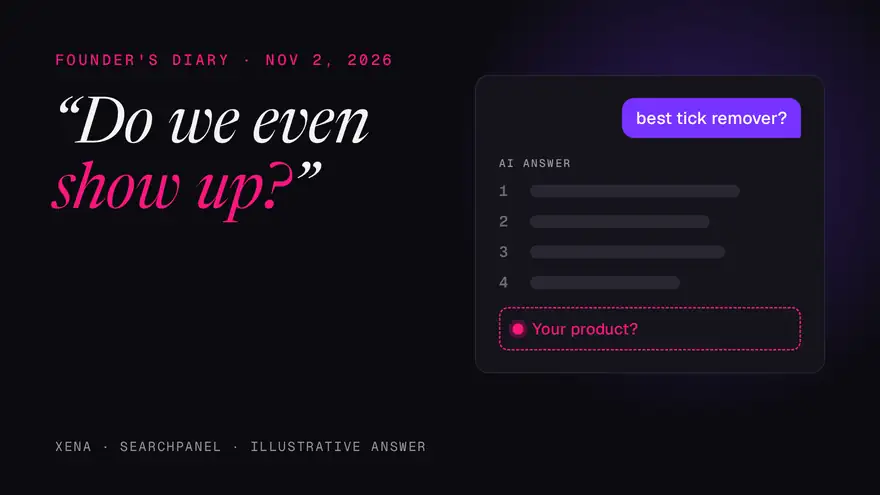
Then, this spring, a CPG founder asked me something different.
"When someone asks ChatGPT for the best tick remover, do we even show up?"
I didn't have an answer. Nobody did. That was the part that bothered me.
A category I had never thought about
My first reaction was not strategic. It was mostly surprise that tick removers are a competitive category. They are. In e-commerce almost everything is, including products you have never once thought about until a founder is paying you to think about them. I have learned more about protein powder, baby monitors and dog shampoo than any person with my job title should admit at a dinner party.
My second reaction took longer. I started thinking about how many questions like that get asked every day. Someone wants the best protein powder. Someone wants the safest baby monitor. Someone has a dog that smells like a dog. A lot of them don't open Amazon first anymore. They ask an assistant, read a short answer with three or four names in it, and then go buy one of those names.
The answer shapes the purchase before the shopper ever sees a search results page. And brands had nothing for it. No dashboard. No rank tracker. No alert when a model stops recommending your product and starts recommending your competitor's.
For a company whose whole business is telling brands where they stand, that is an awkward thing to notice. It felt a bit like running a weather service and finding out people had started checking a different sky.
The shelf keeps moving
I wrote about it on LinkedIn in June, and one line from that post still holds up for me.
The shelf used to be physical. Then it became a search results page. Now it's an answer.
I have some history with shelves changing under me. Before I came to the US, I worked at HT Media in India. I started on the media side, with FM radio studios, and ended up building the company's e-commerce operation. Then I came to Babson, then consulted for small e-commerce businesses, and Xena came out of that work in 2020, in the middle of the pandemic. The brands I worked with were drowning in data and spending hours on ad work that a machine should have been doing. So the machine started doing it.
I'd like to call this a pattern of vision. It is closer to a pattern of being in the room when the old shelf stops working and somebody asks what now.
Three shelves, as I've watched them
- The storebefore e-commerceThe shelf is physical. You win with placement, packaging and a distributor who returns your calls.
- The results page2020 to nowThe shelf is a list. You win with rank, reviews, ads and a listing that answers the obvious questions. Xena's home turf.
- The answer2026The shelf is three or four names in a reply. Nobody scrolls. Either you're in it or you're not.
What we built
In that June post I wrote, "So we built one." We started with a plain idea. Plug in an ASIN and see how models like ChatGPT, Claude and Gemini describe your product, whether they recommend it, and how that changes over time. I called it rank tracking for the AI era, which is the kind of sentence you write after too many pitch meetings. It also happens to be accurate, so it stayed.
A commenter asked how it works under the hood. The version I can give without our engineers sending me a polite message goes like this. SearchPanel asks the questions real buyers ask, across the assistants people use, every day. It records which products get named, which competitors show up, and what sources the answers lean on. Then it tries to work out why you're missing. Sometimes the listing is missing specs. Sometimes the copy is weak. Sometimes it's technical: structured data, crawlability, whether the site has an llms.txt file at all. (This website has one. I checked before writing that sentence, because the alternative was going to be embarrassing.)
Then it drafts fixes based on the brand's own product facts, and the brand approves each one before anything ships. I care about that last step more than it sounds. Nobody wants an AI writing confident nonsense about their baby monitor so that a different AI will repeat it.
The part I think brands underestimate is that it scores each product on its own. A brand can look fine on average while half its catalog is missing from the answers. Averages are very comforting until you look at the individual numbers.
SearchPanel, by its own numbers
From searchpanel.ai and my LinkedIn post of Jun 11, 2026.
Number one, and nowhere
We tested it on our own clients first, which is the only fair way to find out whether you've built something useful or just something interesting.
One result I still think about. A brand held the number one spot on Amazon for its top keyword. That kind of rank doesn't happen by accident. We asked the AI assistants the same question a shopper would ask about that keyword, and the brand was not in the answer. Not low in the answer. Not there.
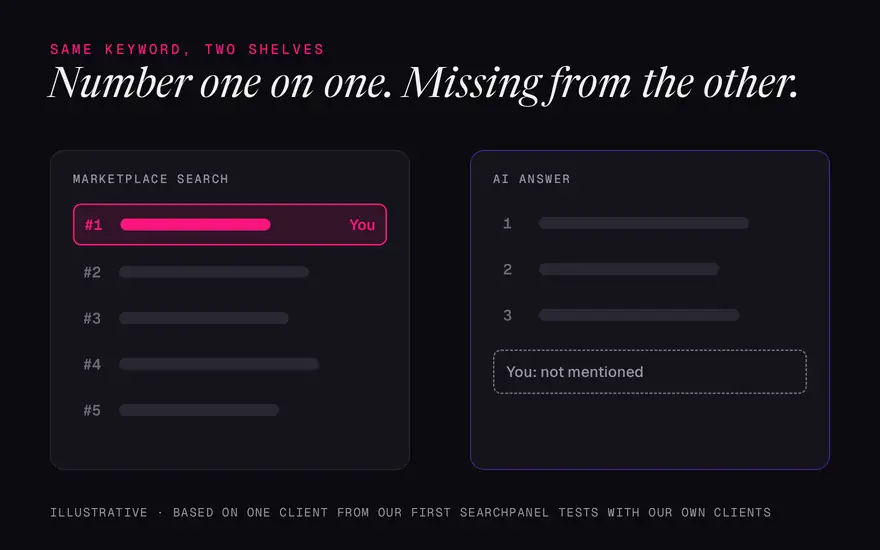
Two weeks of optimization later, they showed up in the recommendations.
I want to be careful with this one. It is one brand and one keyword, and I'm not going to turn it into a percentage. But it proved the thing we suspected. The rank brands spent years earning on a marketplace doesn't carry over to the answer on its own. Those are two different shelves, and most brands are only watching one of them.
One brand, one keyword, in our first tests
- Before YesNumber one on AmazonThe top spot for the keyword that matters most to them.
- Same keyword NoMissing from the AI answerAsked the way a shopper would ask. Other products named. Not them.
- Two weeks later YesIn the recommendationsAfter two weeks of optimization.
From my LinkedIn post of Jun 11, 2026. I'm not naming the brand. It's their business, not mine.
Why a small team could do this
People sometimes ask why a company our size gets to build this at all. Fair. The answer is less exciting than they hope. We had already spent years inside Amazon and Walmart data for more than 100 brands, including Nestle. The hard part of AI search for a consumer brand isn't the AI. It's knowing what a good product page looks like, what shoppers actually type, and which facts about a product matter to the people buying it.
Last November, the team was halfway through a sprint for a large CPG team when the brief changed. The brand had found something new in its Amazon search data. The team rebuilt the whole benefits architecture in hours. Nobody panicked, or if they did, they did it efficiently. That is the kind of muscle you need when the shelf moves every few months.
So when the tick remover question showed up, we weren't starting from zero. We were starting from a large pile of data and a team that has a habit of saying "give me a minute, I'll figure it out."


What I still don't know
I don't know which assistant shoppers will trust most in two years. I don't know whether people will type at all by then, or just talk to their phones while looking for the dog. I do know that "where do we rank on Amazon?" is still a good question. It just isn't the only one anymore, and brands deserve a straight answer to the new one.
I also haven't asked any of these assistants who the best founder in Louisville is. If I ever do, I will share the result only if it goes well.
As for the founder who asked about tick removers, I owe them a thank you. Most of the useful things we have built started as a customer question I couldn't answer. This one was just more specific than most.
I write about the less tidy parts of building Xena in my Founder's Diary newsletter on LinkedIn (opens in a new tab), and the day-to-day version lives on Instagram (opens in a new tab). If you sell something and you're now wondering whether you show up, my calendar is open (opens in a new tab). Bring your category. After this year, I'm not surprised by any of them.
Akhil
Newsletter
Notes from Akhil
Occasional notes on building Xena Intelligence and SearchPanel from Louisville: what's working, what isn't, and what I'm learning.
Get the next entry. Founder's Diary lands on LinkedIn first. Behind-the-scenes moments go on Instagram.