A Hundred Customers, and Two Years of Mumbling the Price
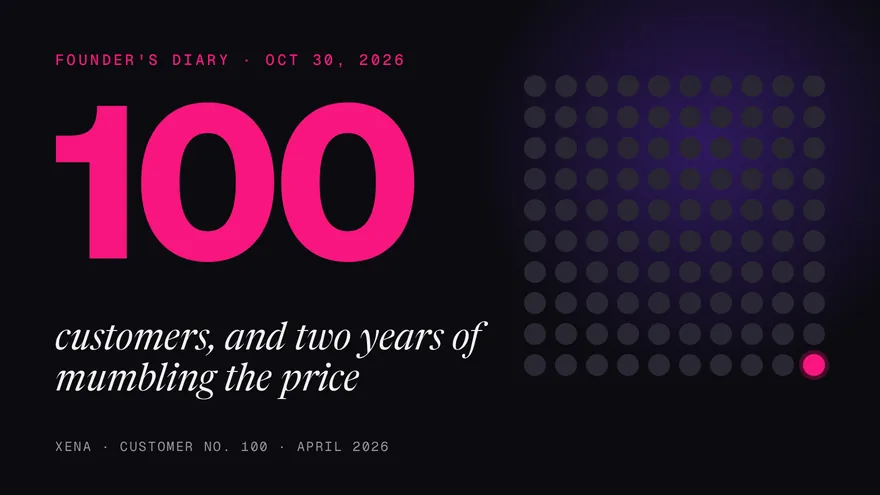
In April, Xena crossed 100 customers. I wrote a post about it, people were kind in the comments, and then I opened my inbox, which had not been told it was a special day.
My parents in Kochi still tell their friends that their son runs an AI company in America. This is despite me trying to explain what Xena does a hundred different ways. My mom, for her part, once asked why I don't just sell on Amazon myself. Both are reasonable responses to my explanations. Neither helps me explain what a hundred customers feels like from the inside.
I've been thinking about that number again this week, for a less flattering reason. For a good stretch of the road to those hundred customers, I was charging them as if I owed them an apology.
This entry is about the customers, and about the price.
Customer number one taught me how to sell. I've said that before, and it sounds wise until you hear the details. I had no deck. I had no case studies either. What I had was a thesis about Amazon that I believed in more than I had believed in anything before.
That is a strong thing to bring to a sales call. It is a weak thing to put on an invoice.
The thesis came out of consulting. After Babson, I ran a small consulting firm called Parzenn Partners with my co-founder Danny, who had lived one floor above me in the dorms. When the pandemic hit, the small businesses we worked with lost a lot of their brick and mortar sales and had to figure out e-commerce quickly, and there was very little real help for them on Amazon. I was no expert. I learned, and a few clients let me test what I learned on their stores. I started building the platform in a bedroom in Delhi, which is not the origin story you hear at most American AI companies.
The first customer bought the thesis. I'm still grateful to them, partly because I'm fairly sure I explained it badly.
What each milestone taught me
- No. 1How to sellNo deck, no case studies. Just a thesis about Amazon.
- No. 10How to deliverStaying up until 3am fixing a listing because a client's Q4 depended on it.
- No. 25How to hireAnd then how to un-hire.
- No. 50How to say noNot every brand is a fit for Xena.
- No. 75Why Xenalytics had to existDashboards weren't enough. Brands needed to know what to do on Monday morning.
- No. 100That the number is never the pointEvery logo is a person who made a bet.
The lessons are from my April 20, 2026 LinkedIn post on crossing 100 customers.
Customer number ten taught me how to deliver. Winning the deal is one job. Staying up until 3am fixing a listing because a client's Q4 depends on it is a different job, and nobody mentions the second one when they congratulate you on the first.
Earlier this month I wrote that clients don't remember your font. They remember the Tuesday you fixed the buy box fire in four hours. I learned that around customer ten. I'm still working on not caring about the font.
Customer number twenty-five taught me how to hire. And then how to un-hire.
I'm not going to write more than that, because the people involved deserve better than to become a paragraph in my diary. I'll only say the second lesson was much harder than the first, and nobody warns you that it comes bundled with the first one.
Fifty, and the word no
Customer number fifty taught me how to say no. Not every brand is a fit for Xena, and pretending otherwise is how startups die.
When you're small, every yes feels like oxygen. Saying no to revenue feels like holding your breath on purpose. But a customer who is wrong for you takes the hours you needed for the ones who are right for you, and those hours come out of the work, which the right customers notice.
Saying no also made it easier to say who we were for. Back in 2022, about 60% of our customers were in the sustainable products space, and I was happy to say so in public.
I wish I had been as comfortable saying the price out loud.
The discount I gave for my own insecurity
For two years, I priced Xena 360 like I was apologizing for existing. Our average contract was around $20,000 a year. Brands were growing on Amazon off our work, and I behaved as if they were doing me a favor by paying the invoice.
I'd love to tell you I figured this out on my own. I didn't. Someone else had to tell me to raise the new-client floor to $2,000 a month. Only after that did I sit down with the math and see that I had been giving clients a discount for my own insecurity.
Same work, two prices (per month)
From my September 29, 2026 LinkedIn post. The first bar is an average across contracts and the second is the minimum for new clients, so they measure slightly different things. $20,000 a year divided by 12 is about $1,667 a month.
The work didn't change. The price did. Nobody blinked.
I've thought about that last sentence a lot. I had spent two years bracing for an argument the customers apparently never wanted to have. The brands were paying for results, and the results were the same. The only person in the room negotiating against Xena was me.
It went deeper than the invoice. Nestlé renewed with us for 24 months, and I still walked into the next enterprise call braced for a no. In the same post I wrote that founders spend four months building a feature and then mumble the price like they're confessing something. I listed myself as Exhibit A. Pricing was Exhibit B. I was the only witness for the prosecution.
How I said things on sales calls, early on
IllustrativeNot measured. Nobody was holding a decibel meter, though in hindsight someone should have been.
I don't think this is a confidence problem you solve once. My guess is that it behaves more like a habit. You notice it, you correct it, and next quarter you catch yourself doing it again in a slightly different outfit.

Seventy-five
Customer number seventy-five taught me that Xenalytics had to exist.
By then it was clear that our clients didn't need one more dashboard. They had dashboards. What they needed was category intelligence that told them what to actually do on Monday morning.
This summer, for example, every SPF pull we ran through Xenalytics for personal care brands said the same thing: the sunscreen aisle you grew up with and the aisle people actually shop are now two different countries. A dashboard can show you that. The useful part is telling a brand which country to show up in on Monday.
Xenalytics also changed how I think about price. When you sell hours, every price feels like a question about whether you're worth it. When you sell a decision someone can act on before their Monday meeting, the price starts to feel like what it is, which is a number attached to a result.
One hundred
Customer number one hundred taught me that the number is never the point.
The point is the founder on the other end of the Zoom call who is tired, underfunded, and betting the next 18 months of their life on an idea.
It's also the category manager at a Fortune 500 who needs a win before the quarterly review, and the operations lead who has already been burned by three agencies and is giving us one last shot. Behind the logo wall there's a working mother in Ohio. A second-generation founder in New Jersey trying to keep her grandfather's brand alive. A food scientist who quit a safe job to chase a better version of a pantry staple. An R&D team inside Nestlé trusting a startup in Louisville with category questions their own consultants could not answer.
None of them were signing up for a slide in my pitch deck. Every one of them decided to trust a first-generation immigrant running a company out of Kentucky. Early on, I described Louisville to my wife as "basically near Chicago." It is not near Chicago. She has mostly forgiven me, and so, it turns out, have a hundred customers.
The hundred, in numbers I've shared publicly
Sources: my LinkedIn posts from April 20, 2026 (100 customers), September 29, 2026 (pricing and the Nestlé renewal), and April 2022 (sustainable brands).
In April I added it all up: $2.4M in capital raised, $1.65M in pitch competition winnings, a Techstars badge, a Kentucky Colonel title. I wrote that it amounted to one simple thing, that we had earned the right to keep going. I still think that's the most accurate way to put it. Nobody hands you the next hundred.
I also wrote that the next hundred would be harder, because Amazon is changing faster than it ever has and Walmart is closing the gap. Then I wrote "Good." I still mean it, most days.
What I'm practicing now is small. Say the price in the same voice as everything else, then stop talking, which is the hard part. The silence after a number used to sound like a verdict to me. Most of the time, I suspect, it's just someone doing math, which is what I'd be doing too.
If you're a founder who has been mumbling your price, I'd like to hear what the number is and how long you've been saying it under your breath. I write about the unpolished middle of building Xena in my Founder's Diary newsletter (opens in a new tab) on LinkedIn, and the behind-the-scenes version lives on Instagram at @akhilsuresh (opens in a new tab). If you'd rather just talk, my calendar is at meeting.akhilsureshnair.com (opens in a new tab). I promise to say my rates at a normal volume.
With love,
Akhil
Get the next entry. Founder's Diary lands on LinkedIn first. Behind-the-scenes moments go on Instagram.